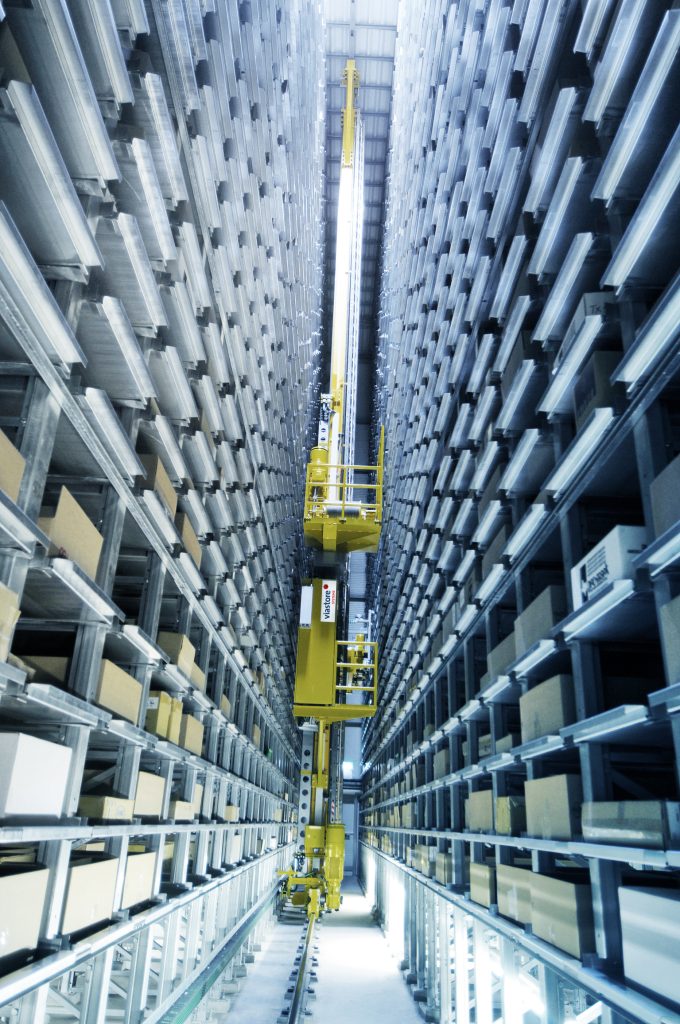
<p>When a warehouse invests in automation, shuttles, cranes, conveyors, sortation systems, it&#8217;s almost always the purchase price and the projected efficiency gains that dominate the business case. Maintenance of the hardware itself tends to end up as a single line near the bottom of the calculation, a percentage assumed rather than calculated. That&#8217;s a mistake that only becomes expensive years later, once the warranty period has ended and wear starts showing for real.</p>
<h2>Why Hardware Wears Differently Than You&#8217;d Expect</h2>
<p>Automation equipment in a warehouse is exposed to a combination of stresses that rarely show up in a technical specification: continuous operation around the clock or across long shifts, temperature swings between heated and unheated zones, dust from packaging and pallet goods, and in some cases vibration from nearby forklifts and conveyors that shortens the life of bearings and fasteners even on equipment that is otherwise correctly specified.</p>
<p>This is why a manufacturer&#8217;s stated component lifespan is almost always a theoretical figure, established under controlled conditions, not a guarantee of how long it will actually last in your specific environment. Two identical shuttles in two different warehouses can have entirely different maintenance needs depending on ambient temperature, dust levels, and actual utilization, not just how many hours they&#8217;ve run.</p>
<h2>The Components That Actually Fail</h2>
<p>In practice, it&#8217;s rarely the large, expensive main units that cause unplanned stops. It&#8217;s instead a handful of comparatively inexpensive, but critical, wear parts.</p>
<p><strong>Drive belts and chains</strong> wear continuously, gradually stretching over time in a way that degrades positioning precision well before it becomes an acute failure. A belt that should have been re-tensioned three weeks ago rarely shows up as an alarm. Instead it shows up as gradually degraded positioning accuracy, more failed or slower pick attempts, sometimes an increase in retries, rather than a clear-cut fault. This is exactly the kind of gradual deviation that&#8217;s easily misread as a software or calibration problem rather than plain mechanical wear.</p>
<p><strong>Bearings and guide rails</strong> in shuttles and cranes are the classic culprit behind unexpected stops. They rarely fail suddenly; they degrade, and that degradation usually shows up as increased power draw or elevated noise long before it shows up as an actual fault. That&#8217;s exactly why vibration and current monitoring is valuable, not because it&#8217;s a trendy technology, but because it catches precisely the kind of gradual deterioration that a scheduled inspection interval easily misses between visits.</p>
<p><strong>Sensors</strong> (photoelectric cells, inductive sensors, laser scanners) are cheap to replace but extremely costly to troubleshoot once they start producing intermittent, hard-to-reproduce faults. A sensor that works 98 times out of 100 is often harder to deal with than one that stops working entirely, because the fault becomes sporadic and easy to dismiss as a one-off until the pattern repeats often enough for someone to take it seriously.</p>
<h2>The Maintenance Strategy That Actually Works in Practice</h2>
<p>Most warehouses move through three stages, often without consciously choosing to.</p>
<p>You start with <strong>reactive maintenance</strong>, fixing whatever breaks. It&#8217;s cheap in the short term, but inevitably leads to stops at the most inconvenient moments; a shuttle that fails in the middle of peak season costs considerably more in lost capacity than the same repair would have cost scheduled on a quiet Tuesday.</p>
<p>The next step is <strong>preventive maintenance</strong>, fixed intervals based on time or operating hours. It&#8217;s a significant improvement, but it has a weak point: the intervals are almost always set from the manufacturer&#8217;s general recommendation, not your actual load. The result is often a mix of unnecessary maintenance on equipment that&#8217;s doing fine, and maintenance that comes too late on equipment wearing faster than average.</p>
<p>The third stage, <strong>condition-based maintenance</strong>, is where the real savings are, but it requires that you actually collect and look at data: vibration levels, power consumption, temperature, cycle times. The point isn&#8217;t to replace a component on a schedule, but to replace it when its own readings show it starting to deviate from normal behavior. That sounds technically advanced, but in practice it often just means systematically logging and reviewing data the equipment is already generating, rather than investing in entirely new sensor hardware.</p>
<h2>Spare Parts Inventory Is a Strategic Question, Not a Warehousing Optimization Question</h2>
<p>An underrated area is how spare parts for automation equipment are managed. Critical components (specific motors, control boards, sensors for a particular shuttle model) often have lead times of several weeks from the supplier, while a production stop costs by the hour, not by the week. That creates an uncomfortable but real trade-off: tying up capital in spare parts that hopefully will never be needed, versus the risk of being stuck without one when the failure actually occurs.</p>
<p>The sensible approach is rarely &#8220;stock everything&#8221; or &#8220;order on demand,&#8221; but a deliberate classification: which components are genuinely critical to the flow (no redundancy, long lead time, high consequence if stopped), and which can you afford to wait for. That assessment is best made together with the supplier, not in isolation internally, since the supplier often has better data on which parts actually fail most often in the field, rather than which ones statistically <em>should</em>.</p>
<h2>Standardization Is the Most Underrated Cost Saving</h2>
<p>If you&#8217;re facing an expansion or addition to your automation equipment, it&#8217;s worth actively striving to keep the number of different models and suppliers down, even if an individual component from a new supplier looks cheaper at the point of purchase. Every new equipment type means a new spare parts assortment, a new body of knowledge maintenance staff have to build up, and a new supplier relationship to manage. The initial saving is often eaten up several times over by the increased operational complexity.</p>
<h2>Conclusion</h2>
<p>Hardware maintenance for warehouse automation isn&#8217;t a line item you can approximate with a flat percentage in the investment case and then forget about. It&#8217;s an ongoing, data-driven discipline that requires actually understanding how your own equipment behaves in your own environment, not just what the supplier&#8217;s manual says. The warehouses that succeed best at it are rarely the ones with the most advanced technology, but the ones that consistently collect, review, and act on the data their equipment is already giving them.</p>

Hardware Maintenance in Warehouse Automation: The Cost Nobody Budgets For