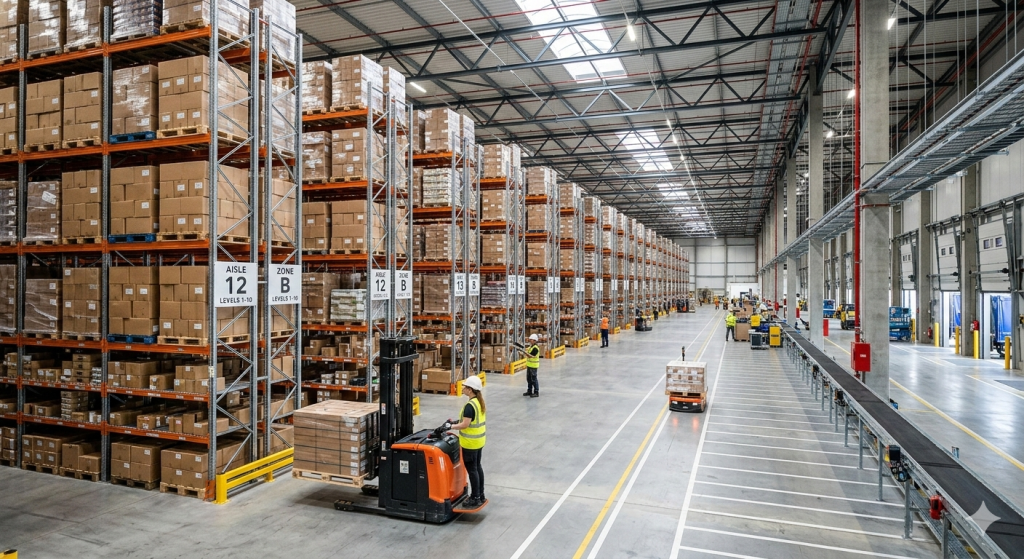
<p>Walk into any major warehouse today and you&#8217;ll find a choreography of controlled “chaos”. Pickers weaving through aisles, conveyors humming, packages sliding into chutes. Behind this “chaos” lies a critical but often overlooked process: order waving. And increasingly, artificial intelligence is transforming how it&#8217;s done.</p>
<p>For decades, warehouse managers relied on fixed rules and intuition to group orders into waves. Today, machine learning models are doing this with remarkable results. This shift is part of a broader move toward <a href="https://roblogistic.com/from-prediction-to-action-agentic-ai-in-warehouse-operations/">agentic AI in warehouse operations</a>.</p>
<p>Order waving is the process of grouping individual customer orders into batches called waves and releasing them to the warehouse simultaneously for picking. Rather than processing orders one by one as they arrive, a wave release sends a coordinated group of orders to pickers at the same time.</p>
<p>Think of it like a conductor cueing sections of an orchestra. Instead of each musician playing when ready, everyone enters at the right moment for maximum harmony. In a warehouse, that harmony translates to reduced travel time, better equipment utilization, and faster fulfilment.</p>
<p>Orders in a wave are typically grouped based on:</p>
<ul>
<li>Carrier or shipping cutoff times (e.g., all FedEx Next Day orders due by 3pm)</li>
<li>Geographic shipping zones or destinations</li>
<li>Product location within the warehouse</li>
<li>Order priority or service level agreements</li>
<li>Order size or item type</li>
</ul>
<p>The goal is to maximize the number of picks completed per labor hour while ensuring orders ship on time. Done well, waving can dramatically reduce the single biggest cost driver in warehouse operations: picker travel time.</p>
<p>For most of the history in modern warehousing, wave planning was a manual, rule-based process. A warehouse manager or a Warehouse Management System (WMS) operating on pre-programmed logic would define grouping rules at the start of a shift and release waves on a fixed schedule.</p>
<p>This approach has served warehouses reasonably well, but it has deep limitations:</p>
<h2>Rigidity</h2>
<p>Fixed rules can&#8217;t adapt to real-time changes. A sudden surge in priority orders, an unexpected staff callout, or a conveyor jam can render a carefully planned wave schedule obsolete within minutes. Traditional systems have no mechanism to respond dynamically.</p>
<h2>Single-Variable Optimization</h2>
<p>Human-designed rules typically optimize for one or two variables at a time usually carrier cutoff and order volume. But warehouse operations involve dozens of interacting variables: picker skill levels, equipment availability, slotting configuration, downstream bottlenecks at packing stations, and more. No rule set can balance all these simultaneously.</p>
<h2>The Waiting Game</h2>
<p>In a wave-based system, an order that arrives just after a wave is released must wait for the next one. During peak periods, that delay can cascade into missed carrier pickups and broken delivery promises the very outcomes waving is supposed to prevent.</p>
<h2>Labor Imbalance</h2>
<p>Static wave plans often create uneven workloads, with some zones overloaded and others idle. This wastes labor and creates bottlenecks that slow the entire facility.</p>
<p><strong>Modern waving with AI</strong></p>
<p>Artificial intelligence and in particularly machine learning and optimization algorithms addresses each of these limitations in ways that rule-based systems simply cannot match.</p>
<h2>Multi-Variable Optimization</h2>
<p>ML models can process dozens of variables simultaneously and find groupings that a human planner would never identify. By analyzing historical pick rates, item locations, order destinations, carrier windows, and labor availability together, AI builds waves that minimize total travel distance across the entire facility not just within individual zones.</p>
<p>In practice, this means pickers spend more time picking and less time walking. Studies of AI-optimized warehouses have shown travel distance reductions of 15 to 30 percent compared to rule-based systems a significant gain when you consider that travel time often accounts for more than half of all picking labor.</p>
<h2>Real-Time Adaptation</h2>
<p>Unlike static rules, AI systems continuously monitor warehouse state and adjust wave composition as conditions change. New priority orders can be slotted into the next wave immediately. A equipment failure on one pick path triggers instant rerouting. Labor reductions mid-shift is automatically factored into downstream wave sizing.</p>
<p>This dynamic responsiveness is perhaps the most transformative capability AI brings to wave planning. It turns a rigid, scheduled process into a continuous, self-correcting system.</p>
<h2>Predictive Demand Forecasting</h2>
<p>AI models trained on historical order data can predict volume patterns by time of day, day of week, season, and promotional calendar. This let’s warehouse managers pre-stage labor and equipment before demand spikes, not after. The result is smoother operations, better carrier compliance, and lower overtime costs.</p>
<h2>Waveless and Hybrid Picking</h2>
<p>The most advanced implementations move beyond discrete waves entirely. Using reinforcement learning, a type of AI that learns through trial and feedback. These systems assign individual picks to workers in real time based on current warehouse state. Every assignment is optimized against every other active assignment simultaneously.</p>
<p>This approach, sometimes called waveless or continuous picking, effectively treats wave planning as a living, moment to moment optimization problem rather than a scheduled batch process. Early adopters report throughput improvements of 20 to 40 percent compared to conventional waving.</p>
<p>The operational gains from AI-driven wave optimization are well documented across a range of fulfilment environments:</p>
<ul>
<li>Pick rates (units per hour) improve as travel time falls</li>
<li>On-time shipping rates increase due to better carrier window management</li>
<li>Labor costs decrease through more even workload distribution</li>
<li>Overtime is reduced because AI anticipates bottlenecks before they develop</li>
<li>Equipment utilization improves as wave timing aligns with conveyor and sorter capacity</li>
</ul>
<p>For large fulfilment operations processing tens of thousands of orders per day, these improvements translate directly to material cost savings and competitive advantage.</p>
<p>The case for AI-driven waving is compelling, but implementation is not without obstacles.</p>
<h2>Data Quality</h2>
<p>AI systems are only as good as the data they&#8217;re trained on. Warehouses with inconsistent inventory records, inaccurate slotting data, or incomplete order history will struggle to realize the full benefit of AI optimization. A data quality initiative is often a prerequisite for successful AI deployment.</p>
<h2>System Integration</h2>
<p>Most warehouse operations run on legacy WMS platforms that weren&#8217;t designed for real-time AI integration. Connecting an AI optimization engine to these systems and ensuring reliable, low-latency data exchange requires significant technical investment — a challenge closely related to <a href="https://roblogistic.com/the-island-problem-in-warehouse-logistics/">the island problem in warehouse logistics</a>.</p>
<h2>Trust and Change Management</h2>
<p>Perhaps the most underestimated challenge is human. Experienced warehouse managers have developed strong intuitions about wave planning over years of practice. Handing control to an algorithm requires trust that is built gradually, through transparent performance reporting and proven results. AI systems that can&#8217;t explain their decisions will face resistance on the floor.</p>
<h2>Explainability</h2>
<p>Related to trust is the question of explainability. Supervisors and pickers need to understand why a wave was built the way it was especially when something goes wrong. Black-box optimization, however technically superior, is difficult to debug and harder to sell to frontline teams.</p>
<p>The trajectory of AI in warehouse logistics points toward increasingly autonomous operations. As AI wave planning matures, the human role shifts from active planner to exception handler intervening only when the system encounters conditions outside its training experience.</p>
<p>Combined with advances in robotics, real-time inventory tracking, and computer vision, AI-driven waving is becoming a cornerstone of the autonomous warehouse. The warehouses of 2030 will look fundamentally different from those of today and smarter wave planning will be a significant part of why.</p>

How AI Is Changing Order Waving in Warehouse Logistics