<p><strong>Warehouse automation</strong> is on everybody’s lips. You might believe automation is the answer to everything. There is, of course, a natural reason behind the automation hype. <strong>McKinsey Global Institute</strong> estimates that the transportation-and-warehousing industry has the third-highest automation potential of any sector. Don’t get me wrong, I am a big fan of technology, but behind this hype, it seems like many companies feel they are forced to invest in automation because they fear falling behind competitors. However, sometimes it seems like companies don’t even know what their main drivers are to automate.</p>
<p>This also applies to companies in the <strong>logistics business</strong> and especially companies that work with <strong>e-commerce</strong> and <strong>omnichannel</strong>. Despite all the buzz talk about automation, many companies are waiting to invest in automation. There are several reasons for that. For example, e-commerce is still a relatively new phenomenon, and there is a great deal of uncertainty about how competition will look in the long term. There is also uncertainty about which technical solutions in automation will prevail in the competition. Many e-commerce companies are also relatively new and have outsourced their logistics to <strong>3PL</strong> companies. The trend of shorter contracts prevents 3PL companies from investing in expensive solutions, as the time of financial depreciation is longer than the contracts. McKinsey research estimates investment in warehouse automation will have the least growth in 3PL, at about 3 to 5 percent per year through 2025. That is half the rate of 3PL companies’ customers, such as retail and automotive, for example (6 to 8 percent), and pharmaceuticals (8 to 10 percent).</p>
<p>However, if you have your main drivers in place and the right expectations, an automation solution can be a great success. By main drivers, I mean what you want to get out of your investment. Is it increased volume efficiency? Increased picking efficiency? How important is flexibility/agility? It is all about cost reduction in some way. The important thing is in which area there is the highest potential to reduce costs significantly.</p>
<p>Of course, the main driver is money, but on what account do you expect to collect it? Is it on labor costs? Facilities (rent/investments in new buildings)? Quality/delivery performance? When I am out networking with colleagues, I often get vague answers when I ask what the main reason is to automate and why they chose the current solution.</p>
<p>If you do not know your main drivers, the risk is you end up with the wrong solution for your purpose. Every solution has its strengths and weaknesses. You always have to compromise on something when choosing a solution. Therefore, it is important to know what your main driver is so you compromise on the right thing.</p>
<p>According to LogisticsIQ’s Warehouse Automation study, order fulfillment in the e-commerce sector is the biggest factor driving the adoption of warehouse automation technologies. After that comes high warehouse rents, shortage of skilled warehouse staff, and increasing staff costs.</p>
<p>My advice is to be careful and think twice before you decide to automate. If your company is in an expansive phase with uncertain order load peaks, it can be wise to stay manual and invest in a competent <strong>WMS</strong> instead. That can do wonders for both labor costs and how you utilize the facilities. The same goes for quality. In that way, you don’t risk being stuck in a solution that can’t handle your peaks like Christmas and Black Friday, for example.</p>
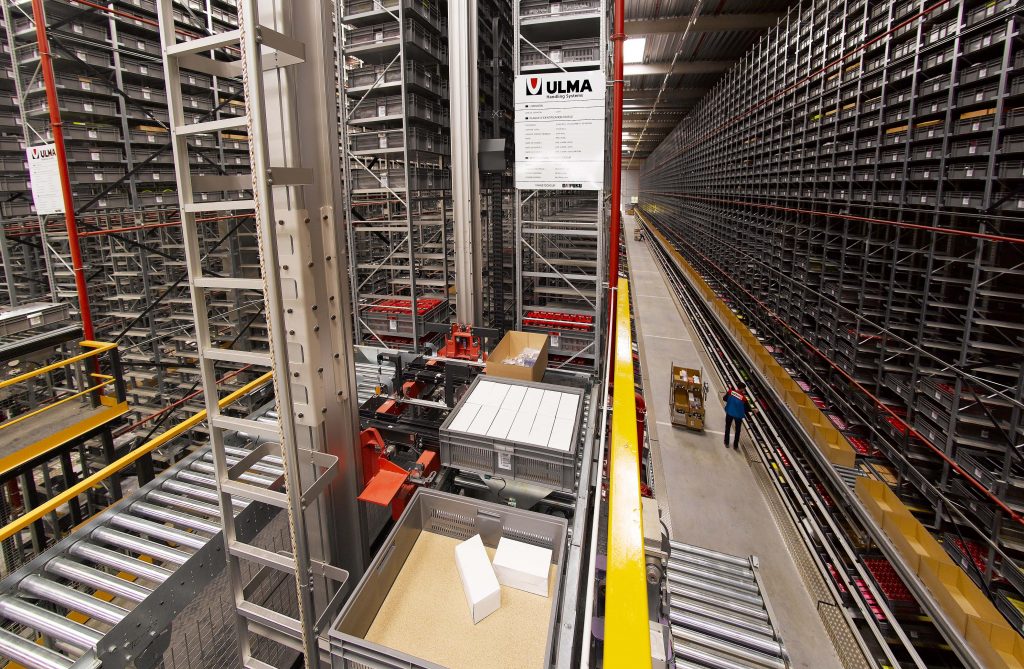
<p>But there are other processes you can automate without using solutions like <strong>automated storage/retrieval systems (AS/RSs)</strong> for picking. For example, <strong>automated guided vehicles (AGVs)</strong> that move cases and pallets between different areas in the warehouse, or autonomous palletizers that use robotic arms to build pallets from individual units and cases, often using advanced analytics to determine the optimal placement for each box. These solutions are easy to supplement with manual labor during peaks in workload.</p>
<p>As I have written before regarding automation, be sure you do not build “monuments” in your flow that are rigid and cannot handle your peaks in workload. Also, consider how easy the solution is to scale up if necessary. If you automate your picking in AS/RS, it’s important to analyze your stock so you do not have a bottleneck immediately. I know it is tempting to put all category “A” products in automation to secure the ROI, but it is better to be careful and slowly increase efficiency.</p>
<p>Another very important thing to consider is which <strong>warehouse control system (WCS)</strong> you should use. Should you use the automation manufacturer’s WCS, or maybe you already have a competent WMS with WCS functionality? Some vendors have begun to implement AI/ML in some functions with great results. That is definitely something to look at before choosing a system.</p>
<p>There is a lot to think about, but with the right competence, an automation investment can be the difference between failure and success.</p>
<p><strong>Roberth Karlsson</strong></p>

Know your main drivers before investing in warehouse automation