<p style="text-align: center;"><em>Proven Methods, People-First Leadership, and a Culture of Continuous Improvement</em></p>
<p>Warehouses are under more pressure than ever. Rising customer expectations, tighter margins, and growing order volumes demand that logistics operations work smarter not just harder. Lean thinking, originally forged on the factory floor at Toyota, has proven to be one of the most powerful frameworks for achieving exactly that in the warehouse environment — and a natural foundation before investing in <a href="https://roblogistic.com/why-warehouse-automation-investments-fail-and-what-you-can-do-about-it/">warehouse automation</a>.</p>
<p>But lean is not simply a toolkit of techniques. At its core, lean is a philosophy — one that places relentless focus on eliminating waste, empowering frontline workers, and building a culture where improvement never stops. In this article, we explore the most effective lean methods for warehouse logistics, explain how they are applied in practice, and examine why the right kind of leadership and genuine employee engagement are what make lean truly stick.</p>
<h1>Eight Lean Methods that is optimal for Warehouses</h1>
<h2>1. 5S The Foundation of Warehouse Order</h2>
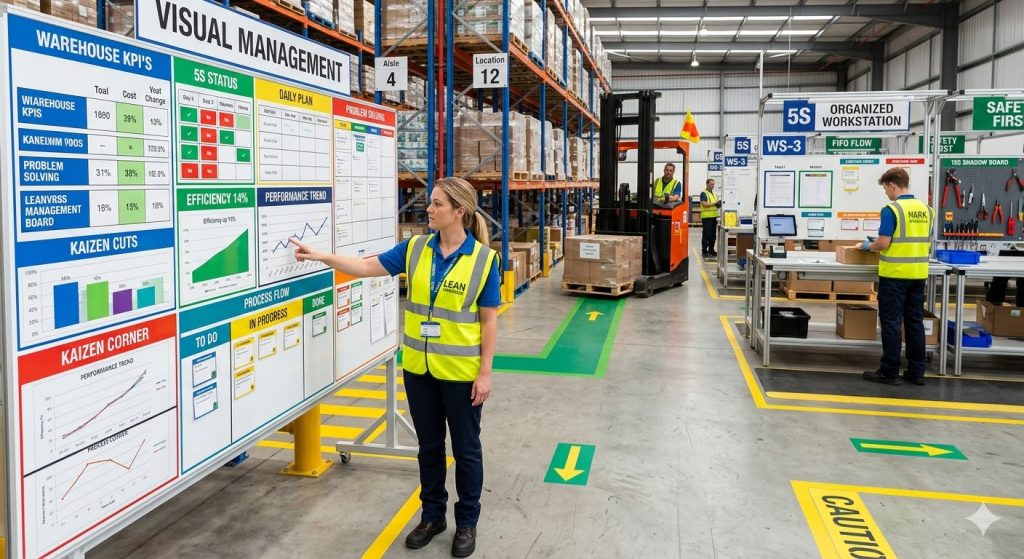
<p>5S is almost always the entry point for lean in a warehouse, and for good reason: it creates the visual order that every other lean method depends on. The five steps Sort, Set in Order, Shine, Standardize, and Sustain work together to transform a chaotic warehouse floor into a well-organized, self-explanatory workspace.</p>
<p>In practice, Sort means clearing out everything that does not belong in the work area obsolete inventory, broken equipment, unused packaging materials. Set in Order means assigning a specific, clearly marked location to every item and every piece of equipment. Shine ensures the workspace is cleaned regularly, which has the added benefit of revealing hidden problems such as leaks, worn floor markings, or misplaced stock. Standardize locks in the new way of working through visual tools like floor tape, label systems, shadow boards, and posted checklists. Sustain is where most organizations struggle: it requires daily discipline and management reinforcement to ensure that the gains are not quietly reversed over time.</p>
<p>The real impact of 5S in a warehouse is felt in every picking route, every shift handover, and every time a new team member needs to find something quickly. When locations are obvious and consistent, pickers waste less time searching, errors drop, and safety improves. Companies that sustain 5S well typically report significant reductions in time spent looking for items and measurable improvements in picking accuracy.</p>
<h2>2. Value Stream Mapping: Seeing the Whole Picture</h2>
<p>Value Stream Mapping (VSM) is a diagnostic tool that gives teams a shared, visual understanding of how workflows through a warehouse from the moment goods arrive at the receiving dock to the point they leave on an outbound truck. It captures both the material flow and the information flow, making invisible inefficiencies suddenly very visible.</p>
<p>To create a VSM, a cross-functional team walks the floor and maps every step a product goes through unloading, inspection, put-away, storage, picking, packing, and dispatch. For each step, they record cycle times, wait times, queue lengths, and error rates. The resulting map typically reveals that most of the time a product spends in the warehouse is non-value-adding it is sitting, waiting, or being moved unnecessarily.</p>
<p>Armed with this picture, teams can target the biggest sources of waste systematically. VSM is also a powerful communication tool: it creates a common language between warehouse managers, operations staff, and senior leadership, making it much easier to align on priorities and track the impact of improvements over time.</p>
<h2>3. Kanban: Pulling Stock Only When It Is Needed</h2>
<p>Kanban is a pull-based inventory system that triggers replenishment based on actual consumption rather than forecasts or fixed schedules. In the warehouse, this means stock is replenished to a picking location only when it drops below a defined minimum not before, and not on a timer.</p>
<p>Physically, Kanban signals can be as simple as a card attached to the last unit in a bin, a two-bin system where an empty bin is the replenishment signal, or a digital alert triggered by a WMS scan. What matters is that the signal is clear, reliable, and acted upon quickly. The beauty of Kanban is its self-regulating nature: when demand picks up, replenishment accelerates automatically; when demand slows, stock does not pile up unnecessarily.</p>
<p>For warehouse logistics, Kanban is particularly effective in managing fast-moving SKUs in pick faces, consumable supplies such as packaging materials and labels, and goods between receiving and storage areas. Organizations that implement Kanban well typically reduce safety stock levels significantly, lower the risk of picking face stock-outs, and free up capital that was previously tied up in excess inventory.</p>
<h2>4. Kaizen: Small Changes, Big Results</h2>
<p>Kaizen is the Japanese term for continuous improvement, and it sits at the philosophical heart of lean. Rather than waiting for a major transformation project, Kaizen encourages every person in the organization from warehouse pickers to team leaders to look for small improvements every single day.</p>
<p>In warehouses, Kaizen takes two main forms. Daily Kaizen involves frontline workers making small, immediate improvements to their own work: rearranging items to reduce reach, suggesting a labeling change, or adjusting a process step to eliminate a recurring error. Kaizen Events (also called Kaizen Blitzes) are short, focused improvement workshops where a cross-functional team spends two to five days intensively improving a specific process area for example, the packing station, the returns handling process, or the inbound receiving flow.</p>
<p>The power of Kaizen lies in its cumulative effect. No single improvement may seem dramatic, but hundreds of small improvements made over months and years compound into transformational results. Companies like DHL and Amazon have built continuous improvement into their operational DNA precisely because of this compounding effect.</p>
<h2>5. Standard Work: Consistency as a Platform for Improvement</h2>
<p>Standard Work is the practice of documenting the safest, most efficient, and most consistent method currently known for performing every repetitive task in the warehouse. It covers the sequence of steps, the time allowed for each step, the tools and materials to be used, and the quality checks to be performed.</p>
<p>In a warehouse setting, Standard Work applies to receiving procedures, put-away methods, picking routes, packing sequences, outbound loading, and equipment operation. When Standard Work is in place, variation drops dramatically. New team members can reach competency faster because there is a clear, documented method to learn. Experienced workers can identify deviations immediately because they know what &#8216;normal&#8217; looks like.</p>
<p>Critically, Standard Work is not meant to be rigid or permanent. It represents the best-known method today, and it should be updated whenever a better method is found. This is what makes Standard Work a platform for continuous improvement rather than a bureaucratic constraint: it sets a baseline, and Kaizen raises that baseline over time.</p>
<h2>6. Just-in-Time Receiving: Right Product, Right Time, Right Place</h2>
<p>Just-in-Time (JIT) receiving aligns inbound deliveries closely with actual operational demand, reducing the need for large buffer stocks and minimizing the floor space consumed by incoming goods awaiting put-away. Rather than accepting large, infrequent deliveries, a JIT approach encourages smaller, more frequent deliveries timed to replenishment needs.</p>
<p>In practice, this requires close collaboration with suppliers and strong demand forecasting capability. Advanced warehouses use cross-docking as an extreme form of JIT: inbound goods arrive, are sorted, and immediately transferred to outbound trucks without entering long-term storage at all. This is particularly effective in retail distribution and e-commerce fulfillment, where speed is paramount.</p>
<p>The benefits of JIT receiving extend beyond space and capital: it reduces handling steps, lowers the risk of damage during long-term storage, and improves stock freshness for perishable or time-sensitive goods. The challenge is that it demands strong supply chain relationships and visibility it is less forgiving of supplier unreliability than a traditional buffer-stock model.</p>
<h2>7. Heijunka: Leveling the Workload Across the Day</h2>
<p>Heijunka is the practice of leveling production or workload volume and mix to avoid the peaks and valleys that cause chaos in warehouse operations. In many warehouses, orders pile up at the start of a shift or spike unpredictably, creating bottlenecks at packing stations and dispatch docks while other parts of the facility are underutilized.</p>
<p>Applying Heijunka in a warehouse context means releasing orders to the picking floor in a smooth, balanced sequence throughout the shift rather than in large waves — a principle closely connected to <a href="https://roblogistic.com/how-ai-is-changing-order-waving-in-warehouse-logistics/">how AI is changing order waving</a>. It means scheduling receiving activities to avoid clashing with peak outbound periods. It means mixing order types and sizes so that the packing area handles a predictable blend of simple and complex orders at any given time.</p>
<p>The result is a calmer, more predictable operation where staff are neither overwhelmed nor idle, equipment is used more consistently, and end-of-shift rushes become the exception rather than the rule. Heijunka requires good planning and scheduling systems, but the investment pays dividends in both productivity and team wellbeing.</p>
<h2>8. Gemba Walks: Leadership Where the Work Happens</h2>
<p>The word &#8216;Gemba&#8217; comes from Japanese and means &#8216;the real place&#8217; — in a warehouse context, that is the floor itself. A Gemba Walk is the practice of leaders and managers going to where the work is done, observing conditions directly, and engaging with the people doing the work to understand problems and identify improvement opportunities.</p>
<p>An effective Gemba Walk is not an inspection or an audit. The manager is not there to catch people doing things wrong they are there to see the process, listen to the workforce, and ask thoughtful questions: What is slowing you down today? What would make this step easier? Where do you see waste? The best Gemba Walks are structured around standard observation checklists but feel like genuine conversations.</p>
<p>Regular Gemba Walks create a feedback loop between the floor and management that is essential for sustaining lean. They signal to the workforce that leadership is engaged and that improvement ideas are genuinely welcomed not just collected and forgotten. Over time, they become a cornerstone of the lean culture.</p>
<h1>Why Employee Engagement Is the Heart of Lean</h1>
<p>Every lean method described above can be implemented as a technical exercise and in many organizations, it is. Tools are rolled out, processes are redesigned, and metrics temporarily improve. Then, within months, the old habits return, the floor reverts to its previous state, and the lean initiative quietly fades into a footnote in the annual report.</p>
<p>The reason is simple: lean without employee engagement is a set of tools looking for a purpose. The tools are not the lean the people are. When warehouse workers understand why lean matters, feel genuinely involved in improvement efforts, and believe that their ideas will be heard and acted upon, something powerful happens: improvement becomes self-sustaining.</p>
<h3>The Three Dimensions of Meaningful Engagement</h3>
<ul>
<li>Understanding the &#8216;Why&#8217;: Frontline workers need to know why lean is being introduced and how it benefits them not just the business. If the message is perceived as &#8216;we want more from you for the same pay,&#8217; engagement will be minimal. If the message is &#8216;we want to remove the frustrating obstacles that make your day harder,&#8217; interest grows.</li>
<li>Genuine Involvement in Problem-Solving: The people doing the work every day know far more about what is broken than any consultant or manager ever will. Lean taps into that knowledge by giving workers structured ways to raise problems and contribute solutions through Kaizen suggestion systems, team huddles, and involvement in Kaizen events. When a picker&#8217;s idea results in a real change, it sends a message that reverberates through the entire team.</li>
<li>Psychological Safety and Recognition: Lean requires people to speak up about problems, admit mistakes, and challenge existing ways of doing things. This only happens when workers feel psychologically safe confident that raising a problem will not result in blame, and that suggesting a change will not be dismissed or ridiculed. Celebrating improvements publicly, no matter how small, reinforces the behaviors that make lean thrive.</li>
</ul>
<p><em>Research consistently shows that engaged employees are more productive, make fewer errors, stay with their employer longer, and contribute significantly more ideas for improvement. In the context of lean, the return on investing in genuine engagement is arguably greater than the return on any single lean tool.</em></p>
<h1>The Leadership Style That Makes Lean Work</h1>
<p>If employee engagement is the heart of lean, leadership is the circulatory system that keeps it beating. The style of leadership present in a warehouse determines whether lean becomes a living culture or a dead program. And the evidence is clear: command-and-control leadership styles are fundamentally incompatible with sustained lean.</p>
<h3>Servant Leadership: Removing Obstacles, Not Directing Traffic</h3>
<p>The most effective leadership style for lean is often described as servant leadership a model where the primary role of managers and team leaders is to serve the needs of their teams. In a lean warehouse, this means identifying and removing the obstacles that prevent workers from doing their jobs well, providing the resources and training that teams need to improve, and creating the conditions in which people want to contribute their best.</p>
<p>A servant leader running Gemba Walks does not arrive on the floor as an inspector. They arrive as a problem-solver and a listener. Their questions are curious and non-threatening: &#8216;What is the hardest part of this process today?’ rather than &#8216;Why are your numbers down?&#8217; This subtle shift in tone changes everything about how the conversation unfolds and how much useful information surfaces.</p>
<h3>Coaching Leadership: Building Capability at Every Level</h3>
<p>Lean organizations invest heavily in developing the problem-solving capability of their people at every level. Managers are coaches, not controllers. Rather than solving problems for their teams, they teach their teams how to solve problems themselves using structured tools like the PDCA cycle (Plan-Do-Check-Act) and A3 problem-solving reports to guide thinking.</p>
<p>This approach takes more time upfront, but it multiplies the organization&#8217;s improvement capacity over time. When a single manager solves problems, the organization improves at the rate of one person&#8217;s thinking. When every team member is a capable problem-solver, improvement happens everywhere, all the time.</p>
<h3>Visible, Consistent Commitment from Senior Leadership</h3>
<p>Perhaps the most frequently cited reason that lean initiatives fail is a lack of genuine commitment from senior leadership. When frontline teams see senior managers engaged in Gemba Walks, asking thoughtful questions, and acting on what they hear, trust in the lean journey builds — the same kind of calibrated trust that matters when <a href="https://roblogistic.com/the-trust-problem-how-much-autonomy-should-you-give-an-ai-agent/">deploying AI agents</a> in operations. When senior leaders delegate lean to a &#8216;lean team&#8217; and focus only on the results metrics, the message heard on the floor is that this is not important.</p>
<p>The most successful lean transformations in warehouse logistics are invariably ones where the operations director or site manager is personally present, personally curious, and personally committed not just in the launch phase, but consistently over years. Lean is a long game, and it requires leadership that plays that game with patience and conviction.</p>
<h3>Humility and a Learning Mindset</h3>
<p>Perhaps the most distinctive characteristic of great lean leaders is humility. They operate from an assumption that they do not have all the answers, that the people closest to the work know things they do not, and that every problem is an opportunity to learn rather than a failure to be punished. This mindset is countercultural in many organizations, but it is the soil in which lean grows.</p>
<p>Leaders who model intellectual humility who openly acknowledge when they do not know something, who change their mind when presented with better information, and who celebrate learning from failures as much as from successes create organizations where continuous improvement is not a program but a way of life.</p>
<h1>Conclusion: Tools Are the Beginning, Not the Destination</h1>
<p>The lean methods described in this article 5S, Value Stream Mapping, Kanban, Kaizen, Standard Work, Just-in-Time, Heijunka, and Gemba Walks are among the most rigorously tested approaches in warehouse logistics. When applied thoughtfully and consistently, they deliver real, measurable results: faster throughput, fewer errors, lower costs, and safer working environments.</p>
<p>But none of them work in isolation from the human dimension of the organization. The most technically perfect 5S implementation will decay without a team that owns and maintains it. The most sophisticated VSM will gather dust without leaders who act on its findings. And no Kaizen event will produce lasting change without a workforce that genuinely believes its voices are heard and its contributions matter.</p>
<p>Lean in the warehouse is ultimately about building an organization that is always getting a little bit better not because it must, but because the people in it want to. That takes the right tools, the right culture, and above all, the right kind of leadership. For organizations willing to invest in all three, the rewards are substantial and lasting</p>

Lean warehouse logistics, Eight Lean Methods For Operational Excellence