


<p>The major focus area in warehouse logistics is still automation, but we must not forget about manual picking and handling. The human element brings a level of nuance and flexibility that&#8217;s hard to replicate with machines. Manual handling still has its advantages in certain cases and in some areas, such as automotive, it will not be possible to automate all handling. Here is an analysis about manual picking and handling where it may be preferable. These are points you should consider before investing in an automation. Often the optimal solution is to combine manual and automated handling. But remember, in order to achieve expected results and optimize the flow and processes you need a very competent WMS. If you look at my blog I have written several articles about WMS.</p>
<ol>
<li><strong> Handling diverse products with ease</strong></li>
</ol>
<ul>
<li><strong>Variety of items</strong>: Human pickers can effortlessly handle a wide range of products, from fragile glassware to oddly shaped equipment or car parts.</li>
<li><strong>On-the-fly adjustments</strong>: Humans can quickly adapt to changes, such as last-minute order modifications or unexpected product substitutions.</li>
</ul>
<ol start="2">
<li><strong> Lower initial investments and cost-effective for various business sizes</strong></li>
</ol>
<ul>
<li><strong>Affordable setup</strong>: Manual picking doesn&#8217;t require significant capital investment in machinery or complex systems.</li>
<li><strong>Ideal for small to medium enterprises (SMEs)</strong>: Businesses with limited budgets or smaller operations find manual picking economically feasible.</li>
</ul>
<ol start="3">
<li><strong> Human judgment and problem-solving with intuitive decision-making</strong></li>
</ol>
<ul>
<li><strong>Quality Control</strong>: Workers can identify damaged or defective items and make judgments that automated systems might miss. A picker notices a torn label or leaking container and takes action to prevent a customer complaint<em>.</em></li>
<li><strong>Exception Handling</strong>: Humans can tackle unexpected situations effectively. If an item is out of stock, a human can suggest an alternative or flag the issue promptly.</li>
</ul>
<ol start="4">
<li><strong> Scalability and workforce flexibility, adjusting to demand fluctuations</strong></li>
</ol>
<ul>
<li><strong>Seasonal scaling</strong>: Businesses can hire temporary staff during peak seasons and scale down during slower periods.</li>
<li><strong>Multi-skilled workers</strong>: Employees can be cross-trained for various roles, enhancing operational flexibility. A team member might pick orders in the morning and assist with shipping labels in the afternoon.</li>
</ul>
<ol start="5">
<li><strong> Reduced dependence on technology and operational reliability</strong></li>
</ol>
<ul>
<li><strong>Less vulnerable to technical failures</strong>: Manual operations aren&#8217;t halted by hardware crashes, when technology fails, human ingenuity can still keep things moving as long as we can reach the products in shelfs or racks.</li>
<li><strong>Simplified maintenance</strong>: Avoids the complexity and costs associated with maintaining advanced machinery.</li>
</ul>
<ol start="6">
<li><strong> Enhanced customer experience and a personal touch</strong></li>
</ol>
<ul>
<li><strong>Customization</strong>: For example, in e-commerce workers can add personalized notes or packaging touches like handwritten quality checks that enhance customer satisfaction.</li>
<li><strong>Attention to detail</strong>: Humans can ensure that presentation meets brand standards, especially important for luxury or high-end products.</li>
</ul>
<p><strong>When manual picking outshines automation</strong></p>
<p>Manual picking isn&#8217;t just a fallback option; it excels in specific scenarios:</p>
<ul>
<li><strong>Complex product handling</strong>: Items that are fragile, perishable, or uniquely shaped benefit from human care</li>
<li><strong>High variability</strong>: Warehouses with a vast array of products or frequent changes in inventory find manual systems more adaptable.</li>
<li><strong>Customer-centric operations</strong>: Businesses that prioritize personalized service often rely on manual processes to deliver that experience.</li>
</ul>
<p><strong>Complementing manual picking with technology</strong></p>
<p>While manual picking relies on humans, integrating certain technologies can amplify efficiency without full automation:</p>
<ol>
<li><strong> Wearable devices and mobile technology</strong></li>
</ol>
<ul>
<li><strong>Smart glasses</strong>: Provide pickers with visual instructions and real-time data. It&#8217;s like giving them a digital map that guides them through the warehouse maze.</li>
<li><strong>Handheld Scanners</strong>: Speed up barcode scanning and reduce errors.</li>
<li><strong>Voice-Picking Systems</strong>: Workers receive audio instructions, keeping their hands free.</li>
</ul>
<ol start="2">
<li><strong> Lean warehouse management</strong></li>
</ol>
<ul>
<li><strong>Optimized layouts</strong>: Strategic organization of inventory to minimize travel time.</li>
<li><strong>Process improvement</strong>: Continuous evaluation of workflows to eliminate waste and inefficiencies.</li>
</ul>
<p><strong>Addressing the challenges of manual picking</strong></p>
<p><strong>Labor Costs</strong></p>
<ul>
<li><strong>Efficiency training</strong>: Educate staff on best practices to boost productivity.</li>
<li><strong>Performance incentives</strong>: Implement reward systems for high accuracy and speed.</li>
</ul>
<p><strong>Human Error</strong></p>
<ul>
<li><strong>Standardized procedures</strong>: Establish clear protocols to minimize mistakes.</li>
<li><strong>Quality checks</strong>: Introduce verification steps for critical tasks.</li>
</ul>
<p><strong>Physical Strain</strong></p>
<ul>
<li><strong>Ergonomic equipment</strong>: Provide tools like lifting aids and adjustable carts.</li>
<li><strong>Regular breaks and rotations</strong>: Prevent fatigue by managing workloads thoughtfully. Rotate staff in all tasks in order to minimize repetitive strain.</li>
</ul>
<p><strong>The interplay between manual and automated picking</strong></p>
<p>Many warehouses find that a hybrid approach yields the best results:</p>
<ul>
<li><strong>Selective automation</strong>: Automate repetitive and heavy tasks while keeping humans in roles that require judgment.</li>
<li><strong>Data analytics</strong>: Use software to analyze picking data and optimize manual processes.</li>
</ul>
<p><strong>Strategic considerations for your warehouse</strong></p>
<p>When deciding on manual versus automated picking, consider:</p>
<ul>
<li><strong>Volume of orders</strong>: Lower volumes may not justify automation costs.</li>
<li><strong>Product characteristics</strong>: If your products require special handling, humans might be preferable.</li>
<li><strong>Budget constraints</strong>: Manual picking allows you to allocate resources elsewhere.</li>
<li><strong>Growth plans</strong>: Consider starting with manual systems and phasing in automation as your business scales.</li>
</ul>
<p><strong>Embracing the future: augmented manual picking</strong></p>
<p>The future isn&#8217;t a binary choice between humans and machines. Instead, it&#8217;s about how technology can augment human capabilities:</p>
<p><strong>Exoskeletons</strong></p>
<ul>
<li><strong>Enhanced strength</strong>: Wearable exoskeletons support workers in lifting heavy items.</li>
</ul>
<p><strong>Augmented reality (AR)</strong></p>
<ul>
<li><strong>Visual aids</strong>: Overlays of digital information on the physical world to guide pickers.</li>
</ul>
<p><strong>Predictive analytics</strong></p>
<ul>
<li><strong>Anticipating demand</strong>: Use data to forecast orders and optimize staffing. Stay ahead of the curve by planning for what&#8217;s coming, not just reacting to what&#8217;s already happened.</li>
</ul>
<p><strong>Final thoughts</strong></p>
<p>Manual picking remains a vital component of warehouse operations, offering advantages that automation alone can&#8217;t provide. By understanding its strengths and strategically addressing its challenges, businesses can:</p>
<ul>
<li><strong>Enhance flexibility</strong>: Adapt quickly to market changes and customer needs.</li>
<li><strong>Maintain personalization</strong>: Deliver a customer experience that stands out.</li>
<li><strong>Optimize costs</strong>: Allocate resources where they have the most impact.</li>
</ul>
<p> ;</p>

Rethinking Manual Handling and Picking in Warehouse
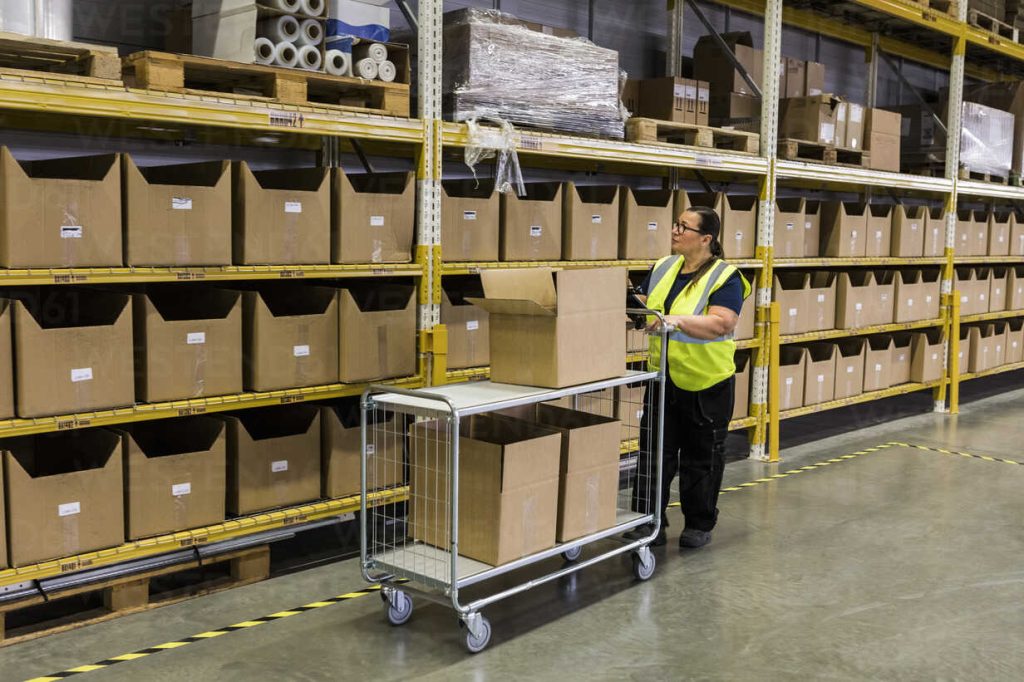
Full length of female worker pushing cart with cardboard boxes by rack at warehouse