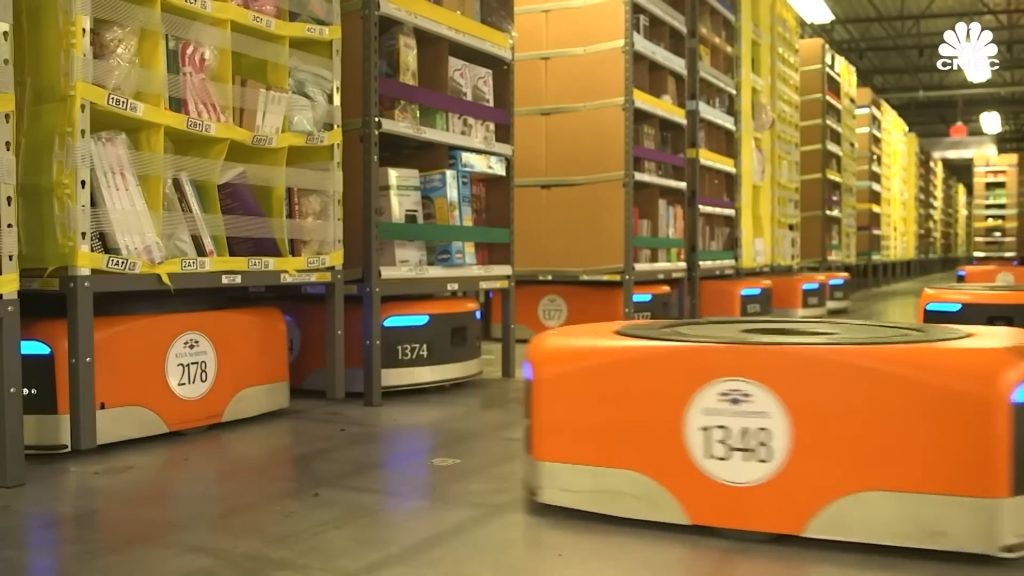
<p>The traditional warehouse was an exercise in fixed efficiency, built around rigid conveyor systems, designated forklift paths, and manual processes. Today, the introduction of Autonomous Mobile Robots (AMRs) is turning this model on its head. Using advanced sensors, AI, and real-time mapping (unlike their fixed-path predecessors, Automated Guided Vehicles or AGVs), AMRs are fundamentally reshaping the architecture of modern logistics, demanding a move from fixed, inflexible systems to dynamic, fluid layouts<strong>.</strong></p>
<p>The architectural impact of AMRs can be summarized in three key areas: Space Optimization, Design Flexibility, and Workflow Fluidity.</p>
<ol>
<li><strong> Space Optimization: Maximizing Density and Height</strong></li>
</ol>
<p>AMRs directly challenge the traditional reliance on wide aisles for human-operated forklifts, which significantly dictates the usable storage capacity of a facility.</p>
<ul>
<li><strong>Rethinking Aisle Widths:</strong> In &#8220;goods-to-person&#8221; (GTP) systems—where AMRs bring inventory shelves directly to a stationary picker—the need for wide human-traffic aisles is drastically reduced. The architectural focus shifts to creating narrower, denser storage configurations that maximize the available floor space for product storage. This is a game-changer for maximizing real estate investment.</li>
<li><strong>Vertical Space Utilization:</strong> While traditional Automated Storage and Retrieval Systems (AS/RS) are excellent for vertical storage, some AMRs are designed to work in conjunction with high-bay or very narrow aisle (VNA) racking systems. By automating the transport of goods to and from these dense areas, AMRs help facilities safely leverage maximum building height, often resulting in a significant increase in storage capacity.</li>
</ul>
<ol start="2">
<li><strong> Design Flexibility: The End of Fixed Infrastructure</strong></li>
</ol>
<p>The core navigational difference of an AMR—its ability to dynamically plan routes and avoid obstacles—is its greatest architectural advantage.</p>
<ul>
<li><strong>Infrastructure-Light Deployment:</strong> Traditional automation often requires costly, disruptive structural changes like embedded tracks, wires, or permanent conveyor installations. AMRs require minimal physical changes. Their ability to map and navigate existing environments means that no permanent or expensive infrastructure changes are needed for deployment. This significantly lowers the barrier to entry and simplifies retrofitting existing facilities.</li>
<li><strong>Adaptability to Change:</strong> The fluid nature of AMR navigation supports a flexible architectural layout. If a warehouse needs to change its product grouping, re-zone its picking area, or adapt to seasonal inventory fluctuations, AMRs can be reprogrammed almost instantly. The warehouse floor becomes a dynamic canvas that can be continually optimized without the expense and downtime of moving fixed systems. This future-proofs the warehouse against changing market demands.</li>
</ul>
<ol start="3">
<li><strong> Workflow Fluidity: Blending Human and Robot Spaces</strong></li>
</ol>
<p>AMRs facilitate a seamless blend of human and robotic activity, requiring architects to design with collaboration and safety at the forefront.</p>
<ul>
<li><strong>Designated Zones and Collision Avoidance:</strong> While AMRs can safely co-exist with humans due to their advanced sensor arrays, optimal design involves clear zoning. Architects must incorporate distinct, well-marked zones for:
<ul>
<li><strong>High-speed AMR transit:</strong> Optimized for robot movement only to maintain efficiency.</li>
<li><strong>Human-Robot collaboration:</strong> Workstations where robots and employees interact for tasks like picking and packing.</li>
<li><strong>Charging/Maintenance Stations:</strong> Strategically placed to minimize AMR travel time to recharge, ensuring fleet efficiency.</li>
</ul>
</li>
<li><strong>Decentralized Processes:</strong> AMRs allow for the decentralization of some processes. For example, instead of all inbound goods funneling to a single point, AMRs can collect and deliver items to multiple localized putaway stations, reducing bottlenecks and improving flow at traditional pinch points like receiving and shipping docks.</li>
</ul>
<p> ;</p>
<p>The impact of Autonomous Mobile Robots is nothing short of an architectural mandate for the future of warehouse design. It is shifting the focus from <strong><u>material-flow-by-infrastructure</u></strong> to <strong><u>material-flow-by-intelligence.</u></strong></p>
<p>The most successful new warehouse designs will embrace this shift, featuring:</p>
<ol>
<li><strong>High-density, flexible storage racking</strong> (maximizing floor space).</li>
<li><strong>Clear, yet adaptable zones</strong> for human-robot interaction and pure AMR transit.</li>
<li><strong>Minimal fixed infrastructure</strong>, prioritizing clear, level, and well-maintained floor surfaces for optimal AMR navigation.</li>
</ol>
<p>By designing for AMRs, companies are not just buying robots; they are investing in an architectural framework that is scalable, resilient, and responsive</p>

The Fluid Warehouse: Architectural Impact of Autonomous Mobile Robots (AMRs)