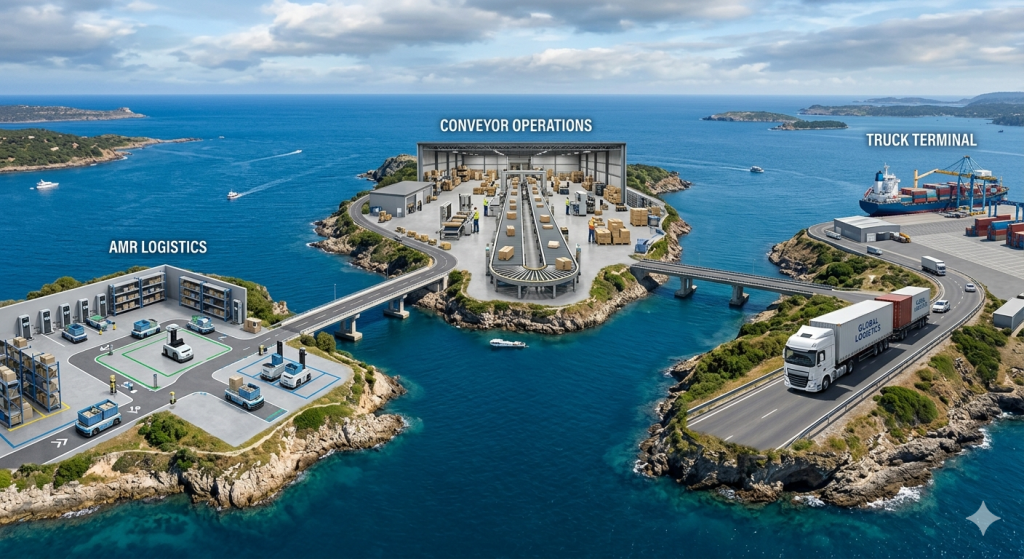
<p><em>How siloed systems and competing AI optimizers quietly undermine the very efficiency they were built to create.</em></p>
<p>Walk into a modern, highly automated warehouse and you will see what looks like a well-orchestrated machine. Conveyors hum. Robots glide. Orders flow. Dashboard screens glow green. Everything, by all appearances, is running optimally. But look more carefully at the data, at the handoffs, at the invisible seams between systems and a different picture begins to emerge.</p>
<p>Beneath the surface, most large warehouses are not one intelligent system. They are several separate systems, each with its own data model, its own optimization engine, and its own definition of success. They share a roof, but often very little else. This is what supply chain practitioners call the island problem and it is one of the most consequential, least discussed sources of inefficiency in modern logistics. It is also a key reason <a href="https://roblogistic.com/why-warehouse-automation-investments-fail-and-what-you-can-do-about-it/">warehouse automation investments fail</a>.</p>
<h1>A Warehouse of Four Islands</h1>
<p>To understand the problem, you first need to understand the four primary systems that govern warehouse operations and how each one sees the world.</p>
<table width="624">
<tbody>
<tr>
<td width="312"><strong>WMS</strong></p>
<p><strong>Warehouse Management System</strong></p>
<p>The strategic brain. Manages inventory positions, order allocation, slotting, and replenishment. Plans in hours and days.</td>
<td width="312"><strong>WES</strong></p>
<p><strong>Warehouse Execution System</strong></p>
<p>The operations coordinator. Orchestrates labor, assigns tasks, balances workloads between humans and robots. Acts in minutes.</td>
</tr>
<tr>
<td width="312"><strong>WCS</strong></p>
<p><strong>Warehouse Control System</strong></p>
<p>The machinery layer. Controls conveyors, sorters, scanners, and automated equipment in real time. Reacts in seconds and milliseconds.</td>
<td width="312"><strong>TMS</strong></p>
<p><strong>Transport Management System</strong></p>
<p>The logistics coordinator. Manages inbound and outbound transport, carrier selection, routing, and dock scheduling. Plans in hours and days.</td>
</tr>
</tbody>
</table>
<p> ;</p>
<p>Each of these systems typically comes from a different vendor, runs on a different data model, and has been configured and increasingly AI-optimized to excel within its own domain. The WMS is scored on inventory accuracy and order fill rates. The WES is measured on labor efficiency and task throughput. The WCS is evaluated on equipment utilization and uptime. The TMS is judged on transport cost and on-time delivery.</p>
<p>None of them are scored on how well they work together.</p>
<p><em>Each individual AI can be performing optimally within its own scope while the warehouse as a whole quietly underperforms. The irony is that every dashboard looks green.</em></p>
<h1>When Optimization Becomes the Problem</h1>
<p>The island problem is not a failure of any individual system. It is a structural failure of the space between systems. And as each system becomes smarter as AI and machine learning become embedded at every layer the problem can paradoxically get worse, not better.</p>
<p>When an optimization algorithm is given a clear objective function and a bounded domain, it will pursue that objective with single-minded efficiency. It will find local optimization that look excellent in isolation. What it cannot see by design is the global system it is part of.</p>
<h2>The conveyor paradox</h2>
<p>A WCS optimized for throughput will push material handling equipment toward maximum capacity. But if the WES has not allocated sufficient pickers to feed the sorter, that speed becomes a liability. Upstream congestion builds. The sorter idles waiting for product. The WCS reports high throughput on the sections that are running the KPI looks fine while the real bottleneck festers elsewhere in the chain.</p>
<h2>The slotting blind spot</h2>
<p>A WMS will optimize product slotting to minimize picker travel distance. This is a legitimate and measurable goal. But the WMS has no visibility into the sortation topology downstream. The products it places in prime locations for fast picking may be precisely the ones that create induction surges the WCS sorter cannot absorb without backup and jamming.</p>
<h2>The wave problem</h2>
<p>Wave management is one of the strongest examples of inter-system friction, and a key reason why <a href="https://roblogistic.com/how-ai-is-changing-order-waving-in-warehouse-logistics/">AI-driven order waving</a> is gaining traction as a cross-system coordination tool. A WES that releases a large work wave to maximize labor utilization will create a predictable surge at the sortation and packing areas shortly afterward. If the WCS has not been informed in real time, not with a 90-second polling delay it cannot prepare. Queue depth spikes. Divert decisions degrade. SLA performance suffers precisely at the moment the system appeared to be working hardest.</p>
<h1>Why It Is So Hard to Fix</h1>
<p>Acknowledging the island problem is easier than solving it. The barriers are technical, commercial, and organizational all at once.</p>
<p>On the technical side, the four systems operate across radically different time horizons. A WMS planning a replenishment cycle and a WCS reacting to a sensor trigger are operating at timescales that differ by four or five orders of magnitude. Meaningful coordination requires not just data sharing but temporal translation understanding what information, at what latency, is actually actionable at each layer.</p>
<p>On the commercial side, WMS, WES, WCS, and TMS vendors have historically competed fiercely. Their systems are built to be best-in-class within their domain, not to expose clean interfaces to rivals. Integration, where it exists, is often achieved through custom middleware that becomes a fragile, expensive maintenance burden over time.</p>
<p>And organizationally, systems often have different owners within a logistics operation. The IT team manages the WMS. Operations runs the WES. Engineering owns the WCS. Cross-functional optimization requires not just technical integration but organizational alignment which is sometimes the harder problem.</p>
<p>A range of approaches are being explored and deployed to address this:</p>
<ul>
<li><strong>Unified orchestration layers.</strong> Logistics control towers that sit above all systems, maintain a global state, and arbitrate conflicting local decisions. Vendors like Manhattan Associates and Blue Yonder are advancing this model aggressively.</li>
<li><strong>Digital twins.</strong> Real-time simulations of the entire warehouse that allow trade-off analysis before decisions are committed to any individual system. Instead of reacting to conflicts, the twin anticipates them.</li>
<li><strong>Event-driven architecture.</strong> Replacing periodic data polling with real-time event streaming so that every system acts on the current state of the warehouse, not a state that is 30 to 90 seconds old.</li>
<li><strong>Platform convergence.</strong> A single platform encompassing WMS, WES, and WCS under one data model and one objective function. Softeon, Made4net, and Infios are building toward this it eliminates inter-system friction at the root.</li>
</ul>
<p><strong>THE FINAL FRONTIER: TRANSPORT INTEGRATION</strong></p>
<p><strong>When the Last Island Remains</strong></p>
<p>Even as the warehouse software industry makes genuine progress on integrating WMS, WES, and WCS into more coherent platforms, one challenge stubbornly remains at the edge of the problem: the Transport Management System.</p>
<p>The TMS operates in a fundamentally different domain. Its optimization problem routing, carrier selection, load consolidation, dock scheduling involves external parties, regulatory constraints, and geographic variables that have no analogue inside the four walls. Most TMS vendors have not traditionally seen themselves as warehouse software companies, and most warehouse software companies have not traditionally seen themselves as transport companies.</p>
<p>The result is a boundary that is particularly hard to bridge. A TMS that schedules an early truck departure to reduce carrier cost may force the WES to release an incomplete wave, cutting fill rates and triggering a costly second shipment. Conversely, a WES that runs a late-breaking replenishment wave to maximize order completeness may cause the TMS to miss a transport window, with knock-on effects across the entire outbound network.</p>
<p>These conflicts are common. They are also largely invisible the TMS books its transport savings and the WMS reports its fill rate, and no system records the cost of the tension between them.</p>
<p>True end-to-end supply chain intelligence requires the TMS to become a first-class participant in warehouse orchestration — much like <a href="https://roblogistic.com/from-prediction-to-action-agentic-ai-in-warehouse-operations/">agentic AI systems</a> are beginning to bridge across these boundaries, sharing real-time transport windows, dock capacity signals, and departure commitments with the systems inside the building. A small number of vendors are working toward this. But for most operations today, the TMS remains the most isolated island of all: physically just outside the warehouse door, but operationally in a world of its own.</p>
<p>The good news is that the industry is moving in the right direction. Convergence is happening not overnight, and not without friction, but with genuine momentum. The warehouse of 2030 will almost certainly be more coherent than the warehouse of today. The question for operators right now is not whether integration matters. It is whether they can afford to wait for the market to deliver it or whether the competitive pressure of the next peak season demands that they start bridging their islands today.</p>

The Island Problem in Warehouse Logistics