<p>For years, warehouse automation was sold on a simple promise: install the robots, cut the errors, lower the cost. That promise held up — right until the world stopped behaving predictably. Tariff shocks, demand swings, labor shortages, and supply disruptions have all made one thing clear: a warehouse that&#8217;s brilliant at executing a fixed plan is still fragile the moment the plan changes. In 2026, the industry conversation has shifted accordingly. It&#8217;s no longer just &#8220;should we automate,&#8221; but &#8220;how flexible is the automation we&#8217;ve bought, and how quickly can it adapt when the ground shifts under it.&#8221;</p>
<h2>Flexibility Becomes Measurable</h2>
<p>That shift shows up first in how success gets measured. Warehouses have always tracked throughput, accuracy, and cost per unit, and those numbers still matter — but a newer question has crept onto the dashboard: how fast can the system adapt when conditions change? Leading operations now track adaptability the same way they track uptime, because in a year defined by geopolitical turbulence and unpredictable demand, the ability to reconfigure quickly is worth as much as raw speed.</p>
<p>The tricky part is that &#8220;flexibility&#8221; has historically been more of a talking point than something you could actually measure. That&#8217;s starting to change. There&#8217;s no single industry-standard metric yet — nothing with the pedigree of OEE — but a few concrete proxies have started showing up on real dashboards. Reconfiguration time, borrowed straight from lean manufacturing&#8217;s changeover-time concept, tracks how long it takes to redeploy the system when conditions change: moving an AMR fleet to a new zone, remapping a robot&#8217;s navigation path, resetting a workflow for a new layout. Fleet scalability ratio turns the vague claim &#8220;we can scale up fast&#8221; into an actual number — how much additional capacity can be brought online within a defined window, typically two weeks, usually through a Robotics-as-a-Service model that lets a warehouse add or return robots on demand. And peak-to-baseline capacity captures something subtler: the ratio between the maximum throughput a system can absorb and its everyday baseline, without a rebuild to get there — a way of checking whether the &#8220;flexible&#8221; label is actually earning its keep, or just describing what the marketing brochure says. None of these are certified standards yet, but together they&#8217;re becoming the de facto way operators turn flexibility from a talking point into something they can track quarter over quarter.</p>
<h2>AI Moves From Forecasting to Real-Time Decisions</h2>
<p>Underneath these new metrics sits a quieter shift in what the software is actually doing. Older automated systems used AI mostly for forecasting — predict demand, then set a fixed plan in motion and let it run. That&#8217;s no longer where the interesting work happens. AI is increasingly running as the decision-making layer inside the warehouse itself, allocating tasks in real time based on live conditions: congestion in an aisle, which workers are free, how much charge a robot fleet has left. Instead of a static plan executed blindly, the system is continuously re-deciding what to do next, the same way a dispatcher reroutes drivers around a traffic jam rather than sending them out with a fixed route and hoping for the best.</p>
<h2>The Conveyor&#8217;s Slow Retreat</h2>
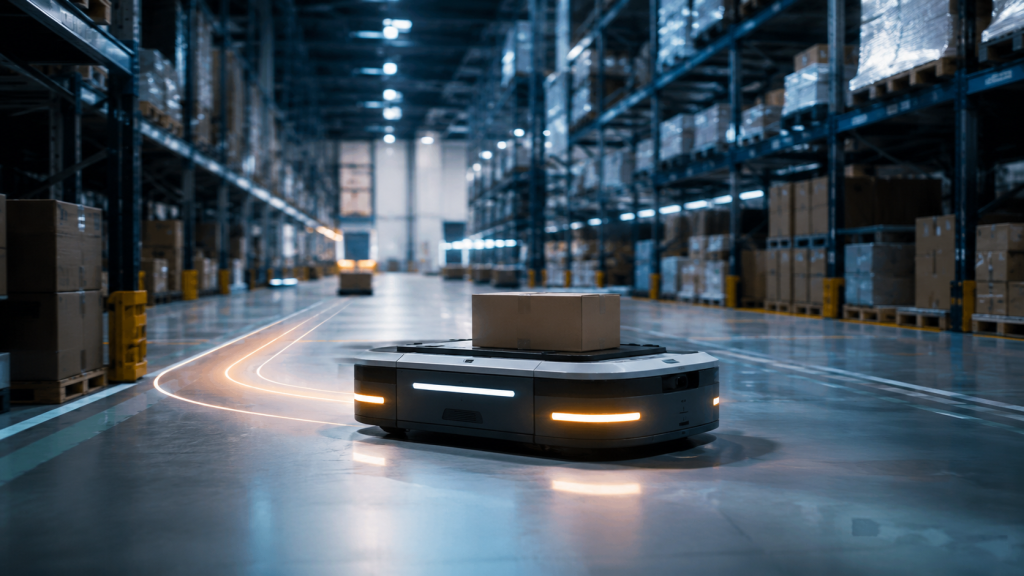
<p>That same logic is reshaping the physical layer of the warehouse, and nowhere more visibly than in the slow retreat of the conveyor belt. Fixed conveyor infrastructure was the backbone of automation for decades, but it has an obvious weakness: it&#8217;s built for one layout and one workflow, and it doesn&#8217;t know how to be anything else. Warehouses are increasingly favoring autonomous mobile robots that can be redeployed between zones as demand shifts — from receiving to a peak-season overflow area, say — without ripping anything out of the floor. Locus Robotics is a good illustration of what that looks like in practice: rather than one robot built for one job, its fleet splits the task, with Locus Origin moving goods between zones and out to dock doors while Locus Vector handles heavier parcels and cases, neither of them tied to fixed tracks or rails, so a facility can reroute them the moment a workflow changes. Zulily took a similar path with Seegrid&#8217;s AMRs, specifically because the retailer kept changing where materials were stowed and what equipment sat on the floor — a fixed conveyor line simply couldn&#8217;t keep pace, and a fleet of mobile robots could.</p>
<p>None of that means the conveyor is disappearing. Most warehouses in 2025–2026 aren&#8217;t ripping every belt out — the more common pattern is hybrid. Fixed conveyors still make sense for the highest-volume, most stable main arteries, where their speed and low per-unit cost are hard to beat. AMRs take over everywhere the workflow is less predictable: feeding spurs, buffering, cross-docking, the variable zones that shift from month to month. It&#8217;s less &#8220;replace the conveyor&#8221; and more &#8220;stop asking the conveyor to do the one thing it&#8217;s bad at&#8221; — flexibility sits where flexibility is actually needed, and raw throughput stays where a fixed line already does the job well.</p>
<h2>Modular, Rentable, and Built to Fit What You Already Have</h2>
<p>That same principle — matching the tool to how much the situation is likely to change — is what&#8217;s pushed modularity from a nice-to-have into something buyers simply expect. Demand uncertainty isn&#8217;t a temporary condition anymore; it&#8217;s the operating environment. So automation increasingly gets bought in phases, sized to scale up as volume grows rather than installed all at once for a forecast that may not hold. It&#8217;s paired with a second, more practical shift: deployment that doesn&#8217;t require tearing up concrete or rebuilding shelving to get running. Modern systems use floor-mapped navigation and simple markers to operate inside existing buildings, which means even older, non-purpose-built facilities can deploy meaningful automation without a construction project attached to it.</p>
<p>Robotics-as-a-Service is what ties the phased, plug-and-play approach together financially. Capital cost has always been one of the biggest barriers to automation, particularly for mid-sized operations, and subscribing to a robotic fleet rather than buying it outright removes that barrier — while making it just as easy to scale the fleet back down again if conditions change. It turns automation from a fixed capital bet into a flexible operating cost, which is precisely the mindset the rest of this shift depends on.</p>
<h2>Someone Has to Orchestrate All of It</h2>
<p>Put all of that together — software that decides in real time, robots that can be redeployed instead of rebuilt, capacity that can be rented instead of bought — and the natural next question is who&#8217;s actually coordinating it all. That&#8217;s arguably the biggest shift in 2026: the hard question has moved from &#8220;which robot should we buy&#8221; to &#8220;how do we manage robots, software, and people as a single coordinated workforce, across more than one site.&#8221; The examples are no longer theoretical. DHL Supply Chain has rolled out SVT Robotics&#8217; SOFTBOT platform across its global warehouse network, cutting the time to deploy new robotics integrations by up to 12 times compared to custom-coded setups, and giving its teams a single dashboard to monitor workforce and automation performance across sites at once. Locus Robotics takes a similar approach with its LocusONE platform, which assigns tasks and balances workload across both robots and human associates in real time, letting multiple warehouse nodes share labor and capacity virtually rather than operating as isolated sites. And at MODEX 2026, integrator Numina Group demonstrated a partnership with Anantak Robotics coordinating AMRs, autonomous pallet jacks, forklifts, and tuggers — a genuinely mixed fleet from different vendors — through a single real-time software layer instead of separate, siloed control systems. The common thread across all three: robots and people are treated as interchangeable resources to be tasked dynamically, not as two separate systems that happen to share a floor.</p>
<h2>The Common Thread</h2>
<p>Every one of these shifts — the new metrics, the AI making live decisions, the AMRs quietly replacing conveyors where it counts, the modular and rentable infrastructure, the orchestration layer tying it all together — points at the same underlying idea. Automation in 2026 is no longer judged solely on how efficiently it executes a known plan, but on how well it survives that plan being wrong. The warehouses getting ahead this year aren&#8217;t necessarily the ones with the most robots. They&#8217;re the ones whose systems can be reconfigured, redeployed, and rescaled without a multi-month project every time the business changes.</p>

Warehouse Automation in 2026: Why Flexibility Has Become the Real Metric