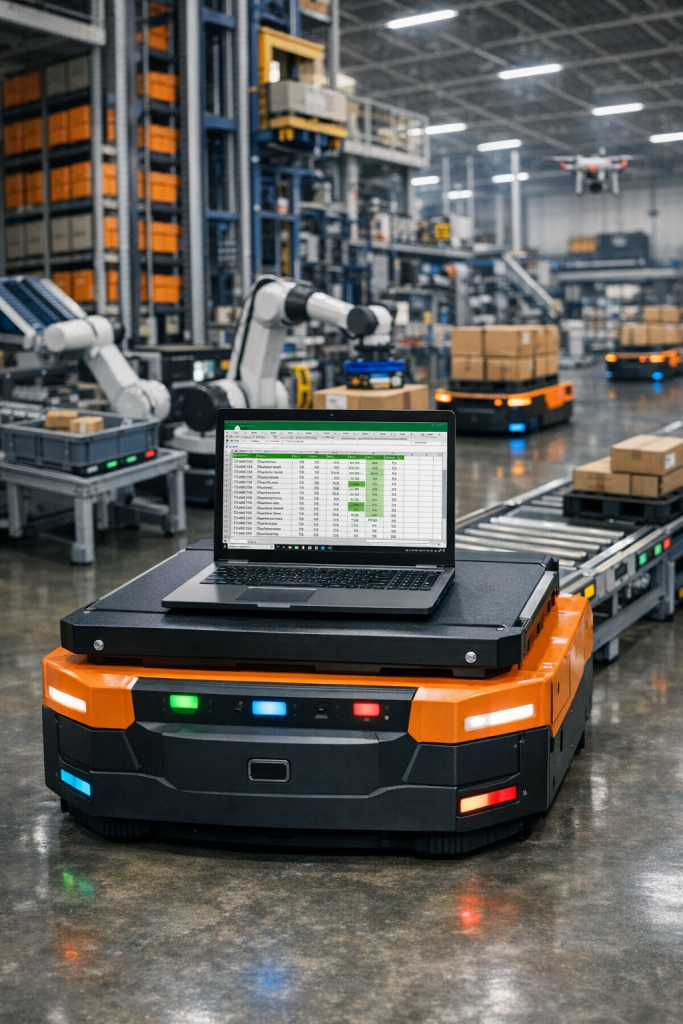
<p>Warehouse automation has attracted substantial capital over the past decade. Driven by rising labour costs, the e-commerce boom, and growing supply chain complexity, businesses across industries have invested in everything from automated storage and retrieval systems (AS/RS) to autonomous mobile robots and AI powered inventory platforms. Yet for all the enthusiasm, the track record is decidedly mixed.</p>
<p>According to McKinsey, a significant portion of warehouse automation projects fail to deliver on their investment, driven not by technology, but by lack of cohesive vision, poor leadership understanding of automation, and organisational misalignment. The causes are well documented and perhaps surprisingly, they rarely come down to the technology itself.</p>
<h2>1. Absence of Strategic Vision</h2>
<p>Many automation projects are launched without a coherent long-term vision. Leadership often lacks a deep understanding of what automation can and cannot achieve, leading to misaligned expectations across the organisation. When different departments operate on different assumptions finance expects a three-year payback, operations expect headcount reduction, and IT expects seamless integration the project is set up for failure before the first robot is deployed.</p>
<p>A robust automation strategy should begin with a clear articulation of objectives: What problem is being solved? How does this investment align with the company&#8217;s growth trajectory and product portfolio evolution? Without answers to these questions, even technically sound implementations will underdeliver.</p>
<h2>2. Poor Data Quality and Inaccurate Forecasting</h2>
<p>Automation systems are only as intelligent as the data fed into them. Inaccurate forecasting of inventory volumes, order profiles, and throughput requirements is one of the most frequently cited causes of project failure. In one well-known case cited by McKinsey, a consumer goods company invested over $150 million to consolidate several warehouses into a single fully automated facility. The projections proved overly optimistic and the system never achieved its intended throughput.</p>
<p>Before committing to large scale automation, organisations must rigorously validate their demand forecasts, SKU profiles, and seasonal variability. Garbage in, garbage out remains as relevant in a robotics context as it does anywhere else in operations.</p>
<h2>3. Integration Failures and &#8216;Automation Islands&#8217;</h2>
<p>A warehouse automation system does not operate in isolation. It must communicate with warehouse management systems (WMS), ERP platforms, order management tools, and transport management systems. When integration is incomplete or fragmented, organisations end up with so called automation islands, pockets of sophisticated technology that cannot effectively exchange data with the surrounding ecosystem. This is precisely what is described in <a href="https://roblogistic.com/the-island-problem-in-warehouse-logistics/">the island problem in warehouse logistics</a>.</p>
<p>Experts consistently identify orchestration the ability to coordinate disparate systems end to end as a greater challenge than the mechanical performance of the automation hardware itself. Investing in integration architecture from the outset is not optional; it is foundational.</p>
<h2>4. Rigid Systems Unable to Adapt</h2>
<p>Traditional fixed automation conveyor systems, large scale AS/RS, and dedicated sorters can be highly efficient in stable, predictable environments. But modern supply chains are anything but stable. Demand volatility, product range expansion, and unforeseen disruptions can expose the inflexibility of rigid systems rapidly.</p>
<p>A 2026 study by Lucas Systems and Wakefield Research, surveying 114 U.S. supply chain executives, found that approximately 60% of organisations with rigid automation systems incurred between 11% and 25% in additional operating costs as a direct result of their inability to adapt to disruptions and new requirements. Scalability and adaptability must be evaluated as core selection criteria, not afterthoughts.</p>
<h2>5. Underestimating the Human Factor</h2>
<p>Perhaps the most overlooked dimension of automation failure is organisational change management. Research shows that 61% of organisations cite change management not hardware or software as the single biggest obstacle to automation success. Workers who do not understand, trust, or engage with new systems will find workarounds. This challenge of building trust is explored in depth in <a href="https://roblogistic.com/the-trust-problem-how-much-autonomy-should-you-give-an-ai-agent/">the trust problem with AI agents</a>. Technology that lacks workforce buy in will sit underutilised.</p>
<p>This extends to pilot programmes, which are often misused. Rather than serving as genuine proof of concept exercises that build internal capability and stakeholder confidence, pilots can become isolated experiments that generate no lasting organisational momentum. The result is technology that works in controlled conditions but never achieves full scale deployment.</p>
<h2>6. Moving Too Fast, Too Large</h2>
<p>Ambition is not a flaw but unchecked ambition in capital intensive projects is a liability. Organisations that leap straight to large, complex automation programmes without first demonstrating value at a smaller scale frequently find themselves locked into expensive solutions that solve the wrong problems. A disciplined approach prioritises low risk, high reward improvements in the near term, for example, starting with <a href="https://roblogistic.com/lean-warehouse-logistics-eight-lean-methods-for-operational-excellence/">lean methods for warehouse operational excellence</a> before committing to large capital investments.</p>
<h2>The Common Thread</h2>
<p>Across all these failure modes, a clear pattern emerges: the technology is not the problem. Robots perform reliably. Conveyors move product. Software, when properly integrated, orchestrates complex workflows with precision. What fails is the strategic, organisational, and planning infrastructure surrounding the technology.</p>
<p>For organisations considering significant automation investments, the questions that matter most are not about the specifications of the hardware they are about vision alignment, data integrity, integration architecture, workforce readiness, and investment sequencing. Answer those questions rigorously, and the technology will follow.</p>

Why Warehouse Automation Investments Fail And What You Can Do About It