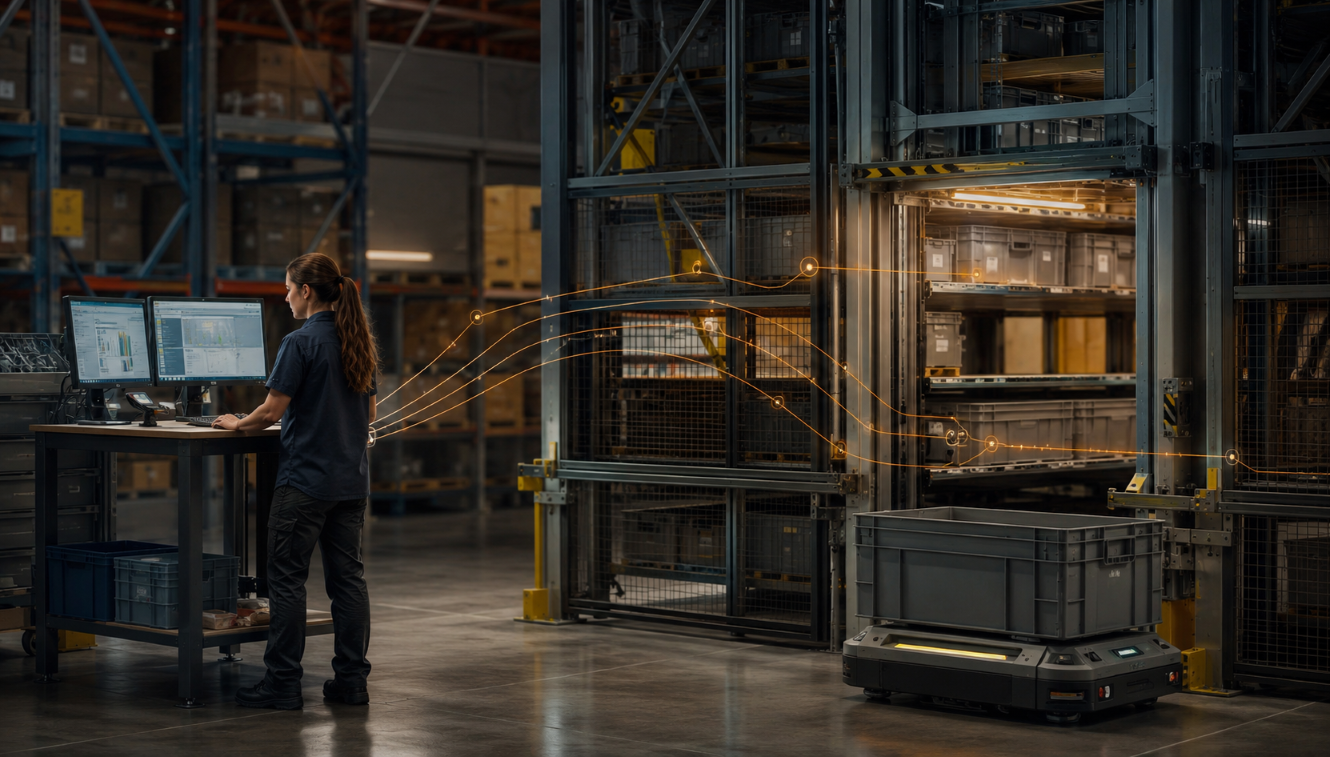
Every automation project I have ever been close to gets sold the same way. There is a business case, a payback period, a vendor demo full of robots gliding smoothly between racks, and a steering committee that signs off once the numbers look right. What almost never appears in that business case is a single line about the people who will actually work alongside the system once it is running. That absence is not an oversight. It reflects how most organizations still think about automation, as a technical problem with a technical solution, where the workforce is something to be managed around rather than designed with.
There is an old idea from organizational research that explains exactly why this approach keeps producing disappointing results. Sociotechnical systems theory, developed by researchers at the Tavistock Institute in the middle of the last century, starts from a simple observation. Every workplace is really two systems layered on top of each other, a technical system of tools, machines and processes, and a social system of people, roles and relationships. Change one without the other and the whole thing underperforms, no matter how good the technology is on its own.
Two systems, one decision
In warehouse automation this shows up constantly, just rarely by that name. A new automated storage system gets specified purely around throughput targets and footprint. The people who will operate it are brought in at the end, for training, once the layout and workflows are already frozen. By then there is no room left to act on what they notice, and there will always be things they notice that nobody in the design phase could have anticipated, because they are the ones who will actually stand next to the machine every day.
The theory calls this joint optimization, designing the technical and social systems together rather than sequentially. In practice it means something quite ordinary. It means asking the people who will run a process, before the layout is locked, what is actually going to slow them down or wear them out. It means treating that input as engineering data, not as a courtesy. It means building in enough flexibility that when something in daily operation turns out to be worse than the simulation predicted, someone has both the authority and the practical means to change it, instead of living with a bad design for the next decade because the steering committee already signed off.
The cost of getting this wrong is not always visible
The failure mode here is not usually dramatic. Nobody walks out. What actually happens is quieter and more corrosive. People get reduced to exception handlers for a system they had no say in, doing the narrow leftover tasks the machine cannot do, with none of the judgment or ownership they used to exercise. Engagement drops. Good people leave for jobs where their experience still counts for something. The ones who stay stop flagging problems early, because early flagging never used to change anything. And all of that shows up eventually in the metrics the original business case cared about, higher turnover, slower onboarding, more errors at the exception points, none of it obviously traceable back to a design decision made a year before go live.
This is also where a well intentioned automation project can quietly become an unfair one. If the technology absorbs the interesting, skill building parts of a job and leaves people with only the repetitive residue, that is not a neutral technical outcome. It is a choice about who benefits from the investment and who carries its cost, even if nobody framed it that way in the steering committee.
What this means in practice
None of this is an argument against automation. It is an argument against treating automation as a purely technical decision that happens to involve people as an afterthought. A few things follow from that.
Involve the people who will operate a new system while the design is still genuinely open, not once it is a fait accompli dressed up as a consultation. Build feedback channels into the operating model itself, not just into the go live checklist, so that what operators learn in month three can actually change something in month four. And when evaluating a vendor or a system design, ask not only what it will do to throughput, but what it will do to the shape of the jobs left behind for the humans still in the building.
The technology will keep getting better. That part is not in question. What determines whether an automation project actually delivers what the business case promised is whether the organization designed the human side of the system with the same seriousness it gave the technical side. Most do not, and it shows, usually about a year after everyone has stopped paying attention.