<p><em>The call came on a Tuesday morning in February. A key client wanted delivery volumes up 40 percent for the spring campaign, starting in six weeks. We had the orders. We did not have the staff, the dock slots, or the racking capacity to handle the ramp. That moment, more than any market report, captures what European warehouse logistics actually feels like right now: relentless pressure from all directions, with less room to maneuver than the industry has seen in decades.</em></p>
<p>European warehouse logistics is being squeezed from every side simultaneously. Rising e-commerce volumes. Tighter real estate markets. An aging workforce that nobody is replacing fast enough. Regulatory demands that keep expanding. And underneath all of it, a technology investment race that most operators cannot afford to lose but many struggle to fund.</p>
<p>This article does not attempt to cover every market in Europe. It focuses on the structural pressures that show up in nearly every serious conversation I have with logistics managers across the continent, and on the solutions that are actually gaining traction rather than just generating conference presentations.</p>
<blockquote><p>The problem is not that European logistics is falling behind. The problem is that the gap between what the market demands and what existing infrastructure can deliver is widening faster than most operators can close it.</p></blockquote>
<h2>The Space Problem Is Structural, Not Cyclical</h2>
<p>The most immediate constraint facing European warehouse operators is not labor or technology. It is space. According to research from Prologis and CBRE, European logistics vacancy rates are projected to remain well below 5 percent in 2026, with some core corridors, including Germany and the Netherlands, even tighter than that. These are not temporary dislocations. They reflect a structural gap between demand and supply that has been building for years.</p>
<p>The reasons are well understood: complex planning regulations, lengthy permitting processes, restrictive zoning rules, and increasingly, capped power grid connections that limit what can be built even where land is available. Prologis research identifies power access as a rapidly rising priority, as automation, data-intensive operations, and electrified transport create energy demands that existing infrastructure cannot always meet.</p>
<p>The practical consequence is that many European warehouse operators cannot simply build their way out of capacity problems. They have to do more with the space they have. That is a fundamental driver behind the shift toward higher-density storage, goods-to-person robotics, and vertical expansion of existing facilities.</p>
<h2>The Labor Problem Is Demographic, Not Temporary</h2>
<p>Workforce challenges in European warehousing are often discussed as if they were a post-pandemic hangover that will eventually normalize. They will not. According to a FreightWaves survey cited by Prologis, 73 percent of warehouse operators report being unable to find enough labor to meet operational demands. The MHI 2025 Annual Industry Report found that 52 percent of companies rate retaining labor as extremely challenging.</p>
<p>These numbers reflect something deeper than a tight job market. In northern and western Europe, the working-age population is shrinking. The people exiting the workforce in logistics are experienced operators with institutional knowledge built over decades. The people entering often lack the digital and technical skills needed to operate modern automated systems. This creates a double bind: you need automation to compensate for fewer workers, but you need skilled workers to run the automation.</p>
<p>This is not a problem that better recruitment practices will solve. It requires a fundamental rethink of how warehouse operations are designed, from the layout of physical flows to the way training is structured and how performance is measured.</p>
<h2>E-Commerce Is Not Slowing Down</h2>
<p>Forrester forecasts that e-commerce sales across Europe&#8217;s five largest economies will grow at a compound annual growth rate of 7.8 percent, rising from 389 billion euros in 2024 to 565 billion euros by 2029. Eurostat data from 2025 shows that 78 percent of EU citizens now buy or order goods online, up from 62 percent a decade ago.</p>
<p>None of this is surprising. What is often underestimated is the operational consequence. E-commerce fulfillment is structurally more demanding than traditional retail distribution. More SKUs, smaller order quantities, faster cycle times, and, critically, higher return rates. Warehouses designed around pallet-in, pallet-out retail replenishment are being asked to handle single-item picking at speeds and volumes they were never built for.</p>
<p>The return problem deserves its own article, and it has one on this blog. But the short version is this: e-commerce return rates in Europe regularly run at 20 to 30 percent in categories like apparel and electronics. Processing those returns consumes space, labor, and system capacity that most facilities are already short of.</p>
<h2>What Is Actually Working</h2>
<p>The solutions gaining real traction in European warehousing share a common characteristic: they reduce dependency on the two scarce resources, space and labor, without requiring a full greenfield build or a nine-figure capital budget.</p>
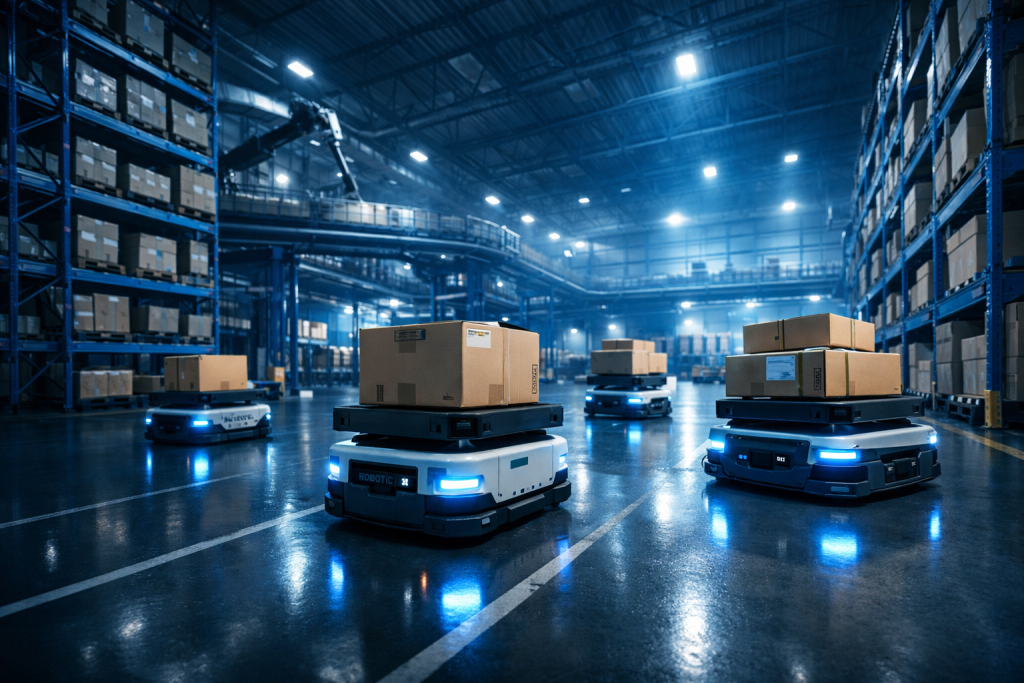
<p>Goods-to-person robotics, particularly autonomous mobile robot systems, have moved from pilot phase to mainstream deployment across medium and large European facilities. The shift away from walker-picker models is not primarily about cost reduction. It is about throughput per square meter and the ability to scale up or down without hiring or laying off large numbers of people.</p>
<p>The Robotics-as-a-Service model has been particularly significant for mid-market operators. Moving automation from a capital expenditure to an operational expense lowers the barrier to entry substantially, and it aligns the provider&#8217;s incentives with the customer&#8217;s operational outcomes in a way that traditional equipment procurement does not.</p>
<p>AI-powered warehouse management is delivering measurable results in demand forecasting, slot optimization, and labor scheduling, particularly when integrated across functions rather than deployed as isolated point solutions. The argument for integrated AI, and against the fragmented island model, is developed in detail in <a href="https://roblogistic.com/the-island-problem-in-warehouse-logistics/">solving the island problem in warehouse logistics</a>.</p>
<p>Labor Management Systems are maturing into a serious operational lever. The combination of engineered standards, real-time task assignment, and performance visibility creates productivity improvements that are difficult to achieve through process improvement alone. The AI dimension of modern LMS is explored further in <a href="https://roblogistic.com/how-ai-is-transforming-labor-management-in-modern-warehouses/">how AI is transforming labor management in modern warehouses</a>.</p>
<h2>The Real Challenge</h2>
<p>The individual pieces of the solution are becoming clearer. The harder problem is integration: making space optimization, automation, workforce management, and technology investment work as a coherent system rather than a collection of separate projects.</p>
<blockquote><p>The warehouse operators who will come out ahead are not necessarily those who invest the most. They are the ones who make the most coherent choices, and who build the operational capability to actually run what they install.</p></blockquote>
<p>The cost of inaction is compounding. Higher labor costs, slower fulfillment, lower accuracy, and reduced attractiveness as an employer all reinforce each other. The operators who moved early on automation and digital tools are already operating with structural advantages that are difficult to close from behind.</p>
<p>The window for getting ahead of this is narrowing. That is not meant as a sales pitch. It is simply what the numbers, and the conversations on warehouse floors across Europe, consistently show.</p>

Challenges in European Warehouse Logistics: A Practitioner’s View