<p>For years, sustainability in logistics was largely a communications exercise. You put a paragraph about it in the annual report, added a green logo to your website, and moved on. That era is over.</p>
<p>Today, sustainability in warehouse operations is not a CSR (Corporate Social Responsibility) initiative. It is an operational and regulatory reality that affects how you run your facility, how your customers evaluate you as a partner, and in some cases, whether you are compliant with EU law.</p>
<p>This post breaks down what is actually changing, what it means for mid-sized warehouse operations, and where the practical levers are.</p>
<h2>From Voluntary to Mandatory: Understanding CSRD</h2>
<p>Most logistics professionals have heard the term CSRD (Corporate Sustainability Reporting Directive) by now, but few outside the finance and legal world know precisely what it means for day-to-day operations.</p>
<p>The Corporate Sustainability Reporting Directive is an EU directive that replaces the earlier, much weaker Non-Financial Reporting Directive. Where the old framework was vague and largely voluntary in practice, CSRD requires standardized, audited sustainability data. It is not enough to say that you care about the environment. You need to show the numbers, and the numbers need to hold up to external scrutiny.</p>
<p>The scope is broad. The directive covers emissions across three categories:</p>
<ul>
<li><strong>Scope 1</strong> covers direct emissions from your own operations, for example gas heating in a warehouse</li>
<li><strong>Scope 2</strong> covers indirect emissions from purchased energy, mainly electricity</li>
<li><strong>Scope 3</strong> covers all other indirect emissions in your value chain, including inbound and outbound transport, packaging, and the activities of your suppliers</li>
</ul>
<p>For logistics operations, Scope 3 is the most complex and the most relevant. It means that the emissions from the trucks delivering to your dock, and the trucks leaving it, are now part of your customers&#8217; reporting obligations. Which means they are increasingly part of how customers evaluate you as a partner.</p>
<p>One important note for 2025 and 2026: the EU&#8217;s so-called Omnibus package introduced a &#8220;stop the clock&#8221; measure that delayed mandatory reporting for Wave 2 companies (those with more than 1,000 employees and over 450 million euros in revenue) by two years. Wave 1, the largest companies already under the previous framework, are still reporting. If you are a mid-sized operation, you may have a longer runway than you thought. That is not a reason to wait. It is a reason to prepare properly rather than scrambling at the last minute.</p>
<h2>What Does a Sustainable Warehouse Actually Look Like?</h2>
<p>Sustainability in a warehouse context tends to cluster around a few concrete areas.</p>
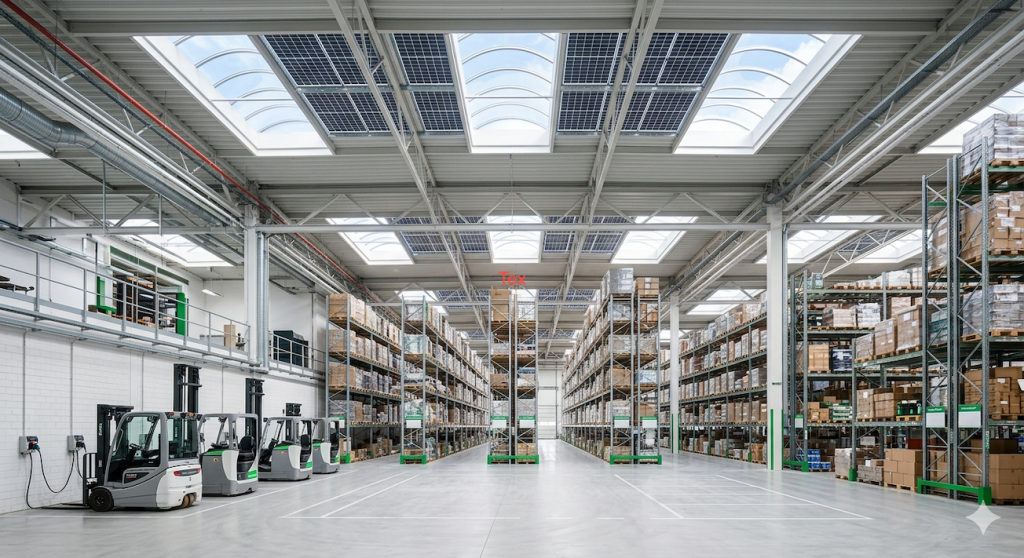
<p><strong>Energy use in the building itself</strong> is the most visible. Warehouse buildings are large, often poorly insulated, and historically energy-intensive due to lighting, heating, and cooling demands. Heating and lighting alone account for 76% of total energy consumption in a typical warehouse, and energy costs represent roughly 15% of overall warehouse overhead expenses (IEA / KPMG, via Meteor Space, 2024). The good news is that well-run energy management programs can reduce energy bills by 5 to 20% without significant capital investment. LED upgrades, improved insulation, solar panels on large roof surfaces, and smarter building management systems are all becoming standard investments with reasonable payback periods. Some facilities are reaching net-zero energy status through a combination of on-site solar generation and automated energy management.</p>
<p><strong>Material handling equipment</strong> is shifting from lead-acid battery technology toward lithium-ion and, in some applications, hydrogen fuel cells. The practical advantages, faster charging, longer lifespan, and lower maintenance, make this a straightforward operational decision in addition to an environmental one.</p>
<p><strong>Waste and reverse logistics</strong> are gaining attention as part of what is increasingly called the circular economy. How you handle returned goods, damaged stock, and packaging materials is now part of the sustainability picture. For operations handling automotive spare parts or similar industrial goods, this often connects to regulatory obligations around hazardous materials as well.</p>
<p><strong>Building certifications</strong> such as BREEAM (Building Research Establishment Environmental Assessment Method) are increasingly requested by large tenants and their sustainability teams when evaluating warehouse locations. If you own your facility, this is worth tracking.</p>
<h2>The Hidden Sustainability Gain from Automation</h2>
<p>Here is something that tends to get overlooked in sustainability discussions: automation is a sustainability tool, not just an efficiency tool.</p>
<p>The numbers make the case clearly. Manual picking operations carry error rates of up to 4%, while automated systems bring that down to 0.04% or lower, achieving 99.96% to 99.99% accuracy (Synkrato, 2026). Those errors are not just an operational nuisance. Distribution centers lose an average of $585,000 per year to picking mistakes, roughly $30 per mis-pick when accounting for wrong items shipped, expedited redelivery, restocking, and lost sales (MHL News, 2025). And the environmental cost of returns is substantial: 20 to 30% of online purchases are sent back, generating roughly 24 million metric tons of CO2 per year globally (MHL News, 2025).</p>
<p>The connection is straightforward. Better inventory visibility means fewer picking errors. Fewer picking errors mean fewer returns and fewer redeliveries. Fewer redeliveries mean fewer truck movements and lower emissions. At scale, this is not a marginal effect.</p>
<p>Similarly, higher inventory accuracy allows for smarter shipment consolidation and better route planning. If you know exactly what you have and where it is, you can fill trucks more efficiently and reduce the number of journeys. The sustainability benefit is a direct consequence of operational precision.</p>
<p>This framing matters because it changes the business case. You are not investing in automation to be green. You are investing in automation to reduce errors, improve throughput, and lower costs. The emission reductions follow from the same decisions. And the investment case is solid: automating picking operations typically delivers a payback period of two to three years, and most systems remain in operation for well over a decade (SellersCommerce, 2026).</p>
<h2>Sustainability as a Customer Requirement</h2>
<p>The shift from voluntary to required is happening not just through regulation but through commercial pressure.</p>
<p>Large manufacturers and retailers operating under CSRD obligations need their logistics partners to provide verifiable emissions data. If you cannot tell a customer what the carbon footprint of their inbound and outbound flows through your facility is, you are a gap in their reporting chain. That gap creates risk for them, and over time, it creates risk for your commercial relationship.</p>
<p>This is especially relevant for operations serving automotive OEMs or large retail chains. These are precisely the kinds of buyers who are under the most intense scrutiny from their own customers and investors.</p>
<p>The practical implication is that sustainability reporting capacity, the ability to measure, track, and share accurate emissions data, is becoming a baseline commercial requirement rather than a differentiator.</p>
<h2>Where to Start</h2>
<p>For a mid-sized warehouse operation that has not yet formally addressed sustainability, the priority list is roughly as follows:</p>
<p>First, understand your energy consumption in detail. Electricity, gas, fuel for internal equipment. This is your Scope 1 and 2 baseline and it is where you have the most direct control.</p>
<p>Second, map your Scope 3 exposure. Which transport flows in and out of your facility are your customers likely to ask about? Working with carriers that can provide emission data per shipment is becoming standard practice.</p>
<p>Third, assess your building. Lighting, insulation, roof surface for solar, and building management systems are all areas with relatively straightforward investment logic.</p>
<p>Fourth, look at your WMS and data quality. Good sustainability reporting depends on good operational data. If your inventory accuracy is poor or your system cannot track movements at the level needed, fixing that is a prerequisite for meaningful emissions tracking.</p>
<p>Finally, know your reporting obligations. Even if you are not directly subject to CSRD yourself, your customers may be asking you to contribute data to their reports. Understanding what they need and building the capability to provide it is a competitive advantage today and a baseline requirement tomorrow.</p>
<h2>The Operational Lens</h2>
<p>The frame that makes most sense for warehouse managers and logistics leaders is not the CSR frame. It is the operational efficiency frame. The investments that reduce energy consumption, eliminate waste, improve equipment reliability, and increase inventory accuracy are the same investments that reduce your environmental footprint.</p>
<p>Sustainability, in this context, is not something you add on top of good operations. It is what good operations look like when you account for all the costs, including the ones that are increasingly being measured, reported, and regulated.</p>
<p>The companies that will find this transition easiest are the ones that were already running tight operations. For everyone else, the pressure is building. The time to start is before the deadline, not after it.</p>

Green Warehousing: Why Sustainability Is Now an Operational Imperative