Everyone talks about where to put the racking when a warehouse goes autonomous. Almost nobody talks about where to put the people, and that is the decision that actually determines whether the deployment works.
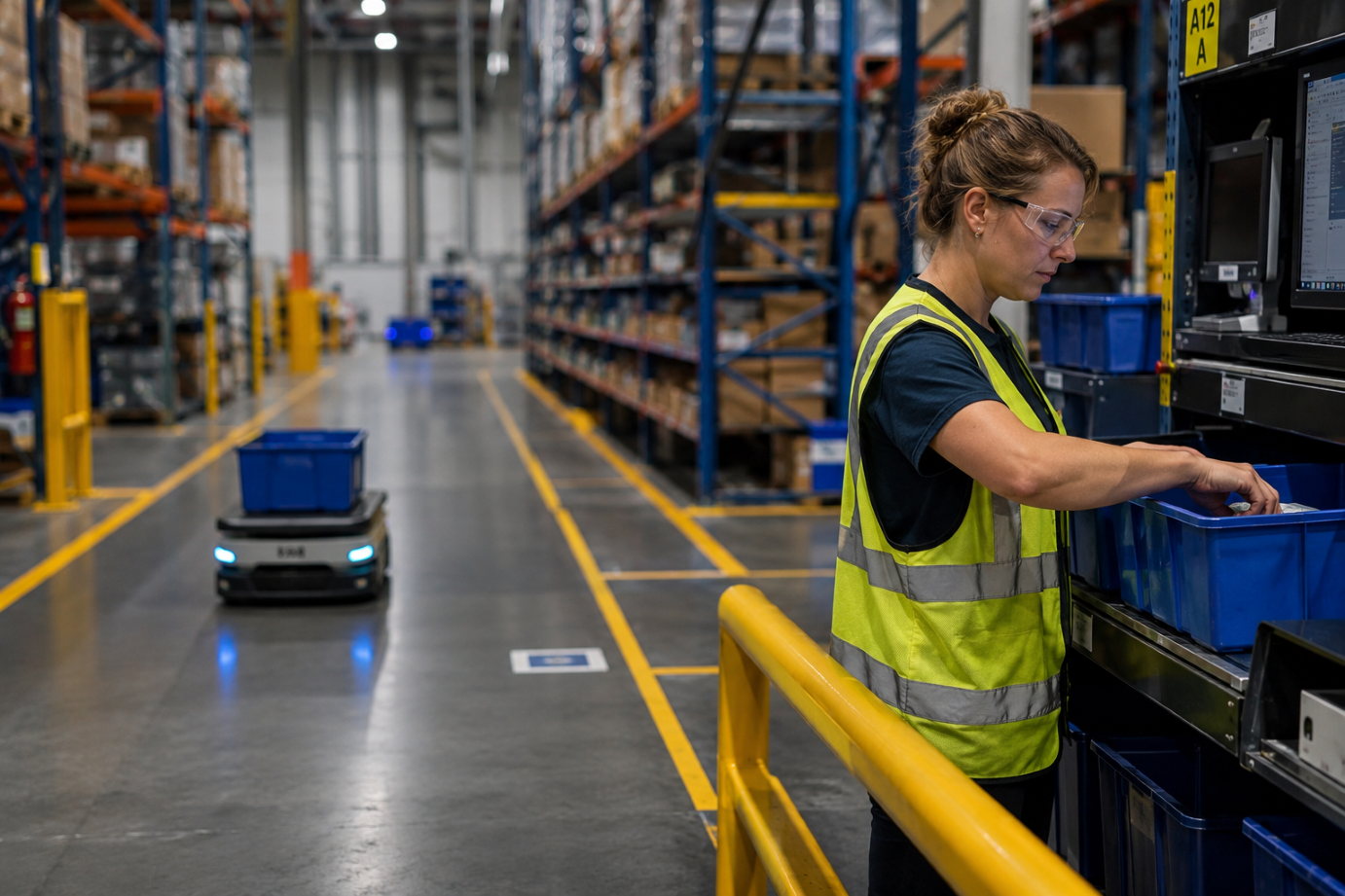
An associate reaches into a tote to pull a part. Two meters away, an AMR carrying a full load rounds the corner at cruising speed. The robot’s sensors register the person, slow the unit, and route around without incident. Nothing happens. No accident, no near miss report, no safety meeting.
But the associate’s pulse just spiked, and for the rest of the shift they will work a little differently around that aisle. Slower. More watchful. Less trusting of the machine that, by every technical measure, did exactly what it was supposed to do.
This is the gap that most AMR conversations skip past. The technology can be flawless and the deployment can still fail, because the thing that determines whether people and robots actually work well together on the same floor is not sensor performance. It is design, and most of that design is invisible until you have already built it wrong.
The zone map is not a formality
Every AMR vendor will tell you their robots detect obstacles, slow down, and stop safely. That is true, and it is also not the point. A facility that treats “the robots are safe” as the end of the conversation is the facility that ends up with congestion at every pick station and a workforce that has quietly stopped trusting the machines within the first month.
A working AMR floor plan needs at least four distinct zone types, each with different rules:
High-speed transit. Corridors where robots move at full speed and human traffic is deliberately routed around, not through. This is where most of the throughput comes from, and it only works if people are not expected to cross it casually.
Human-robot collaboration points. Fixed workstations where a robot delivers a tote or a shelf and a person picks from it. These need generous approach space, clear visual signals for when a robot is arriving or departing, and enough buffer that a queue of robots does not become a queue of frustrated pickers.
Charging and maintenance zones. Positioned off the main transit lines but close enough that dead-heading a low-battery robot back to charge does not eat into fleet availability. Get this placement wrong and you either lose throughput to travel time or you create a secondary congestion point right where you did not want one.
No-go or restricted zones. Areas where the physical environment (racking configuration, dock congestion, low visibility corners) makes mixed traffic genuinely risky, regardless of what the sensors can technically handle.
None of this is exotic. What is easy to underestimate is how much these four zones interact with each other under real load, not under the vendor’s demo conditions.
The sensors are the easy part
Modern AMRs are governed by real safety standards, ISO 3691-4 for driverless industrial trucks among them, and the behavior is fairly consistent across vendors: robots cruise around 2.0 meters per second in open transit, drop to somewhere between 0.5 and 1.0 meters per second when a person is detected nearby, and hold a stopping margin in the range of 30 to 50 centimeters before any obstacle. Emergency stops are accessible from multiple sides. Audible and visual warnings fire when a robot approaches from behind.
That is table stakes, not differentiation. Every credible vendor meets it.
What is not table stakes, and what almost nobody plans for explicitly, is the human side of that interaction. Research on perceived safety in mixed human-robot warehouse environments has found something that will not surprise anyone who has spent time on a warehouse floor: a robot moving in a straight, predictable path is trusted far more than one that curves or hesitates, even when the curved path is objectively just as safe. Predictability, not just safety compliance, is what determines whether your team relaxes around the robots or spends every shift tense.
Some of the more recent work in this space goes further, using vision systems to estimate whether a person has actually noticed the robot approaching, rather than just treating every human as an obstacle to be avoided at maximum caution. It is an early field, but the direction is telling. The next competitive edge in AMR deployment will not be robots that avoid people better. It will be robots, and layouts, designed around how people actually perceive and react to them.
Charging is a layout decision, not a facilities afterthought
Charging infrastructure gets treated as an electrical question when it is really an operational one. A common mistake is sizing chargers 1:1 against the fleet, which is rarely necessary and expensive to build. Most mature deployments run charger-to-robot ratios closer to 1:2 or 1:3, relying on opportunity charging during natural lulls rather than dedicating a charger to every unit. That only works if the chargers sit where the natural lulls actually happen, which means the charging zone has to be designed alongside the workflow, not bolted onto whatever spare corner of the building was left over.
Get the ratio and placement wrong and you do not find out in the planning meeting. You find out three weeks into live operation, when fleet availability quietly drops during peak shift and nobody can immediately say why.
Decentralization solves a bottleneck problem, if you let it
One of the genuine architectural advantages of AMRs is that they do not require every process to funnel through a single point. Instead of all inbound goods converging on one receiving dock and one putaway lane, AMRs can collect and deliver to multiple localized putaway stations across the facility. That reduces the pressure on the traditional pinch points, receiving and shipping, where a huge share of warehouse delay actually originates.
But decentralization is a double-edged design choice. It reduces central bottlenecks and creates several smaller, distributed ones instead. If those distributed stations are not each properly zoned, each with their own approach space and their own handoff logic, you have not eliminated the congestion problem. You have just multiplied it and made it harder to see on a single dashboard.
Run it small before you run it everywhere
The operational research on this is consistent: the failure modes that actually show up in live AMR deployments are not exotic technical failures. They are congestion from poor traffic rules, human interference with robot paths because zoning was unclear, and battery-related downtime from charging infrastructure that was sized or placed wrong. All three are design problems, not robot problems.
Which is why the sites that get this right tend to run a short, deliberate pilot before scaling, often two to four weeks, watching a small zone closely: how often does a robot stop for a person, how long do queues build at handoff points, how many times does a supervisor physically intervene to reroute something. Those numbers tell you more about whether your zone design works than any vendor specification sheet.
The part that never shows up in the technical spec
There is a version of this conversation that stays entirely in the language of sensors, standards, and layout diagrams. It misses the actual determinant of success, which is whether your people trust the system enough to work naturally around it.
That trust is not built by a safety briefing on day one. It is built by robots that move predictably, zones that make sense to someone walking the floor without a map in hand, and a workforce that was told honestly what the deployment means for their role rather than left to guess. Get the zoning right and the robots fade into the background of a normal shift. Get it wrong and every associate on the floor becomes an unpaid, unwilling safety inspector, watching the robots instead of doing their job.
The architecture debate over where to put the racking matters. But the zoning debate over where to put the people is the one that actually decides whether the investment pays off.