<p><em>A deep look at the three supply chain layers that determine profitability for European online retailers.</em></p>
<p><em>European e-commerce is booming but growth without margin discipline is just expensive logistics. The good news is that research now points clearly to where the money is being left on the table, and which levers actually move the needle.</em></p>
<p>For most European online retailers, the path to profitability runs through three connected layers: how goods arrive into the network (inbound), how they are stored and processed (warehousing), and how they reach the customer (last mile). Each layer has its own cost dynamics, its own set of emerging technologies, and its own body of research pointing toward best practice. Understanding all three and how they interact is increasingly the difference between an e-commerce operation that scales sustainably and one that grows itself into a loss.</p>
<p>The European context adds further layers of complexity that US-centric research often misses like regulatory fragmentation across member states, a dense urban geography that complicates last-mile delivery, strict sustainability mandates from Brussels, and a labour market under severe structural pressure. Each of these creates both cost risk and if handled strategically meaningful competitive advantage.</p>
<table width="624">
<tbody>
<tr>
<td width="208"><strong>€614B </strong><strong>European e-commerce logistics market projected by 2033</strong></td>
<td width="208"><strong>60–70% </strong><strong>Share of total delivery cost attributable to the last mile</strong></td>
<td width="208"><strong>470k+ </strong><strong>Logistics jobs unfilled across the EU in 2024</strong></td>
</tr>
</tbody>
</table>
<h3><strong>Layer 01 · </strong>INBOUND TRANSPORT</h3>
<h4><strong>Inbound Transport: The Quiet Margin Lever</strong></h4>
<p>Inbound freight is rarely the flashiest topic in e-commerce strategy discussions, yet network design decisions made here ripple through every downstream cost. Where you position your distribution nodes and how goods flow into them shapes your cost base for years.</p>
<p>Europe’s geography is both an asset and a complication. The continent’s dense port infrastructure, its east–west labour cost gradient, and its multimodal connectivity (road, rail, sea) mean there is genuine strategic choice available to retailers willing to think beyond the obvious. Western European logistics hubs remain dominant by volume, but the centre of gravity is shifting. Eastern and Central Europe now offer a compelling combination of lower operating costs, improving infrastructure, and central positioning relative to both manufacturing sources and consumer markets. Retailers that have relocated or expanded their inbound hub operations eastward have in many cases reduced their inbound unit cost meaningfully, while also cutting transit times to growing Eastern European consumer markets.</p>
<table width="624">
<tbody>
<tr>
<td width="624"><em>“The logistics centre of gravity in Europe is moving east and the margin opportunity is moving with it.”</em></td>
</tr>
</tbody>
</table>
<p>The regulatory environment is about to reshape inbound economics in a significant way. The European Union is in the process of abolishing the longstanding low-value customs duty exemption a threshold that until recently allowed billions of parcels per year to enter the EU from Asian origins without customs duty. With approximately 4.6 billion items having entered under this exemption in 2024 alone, the reform represents a structural shift in the competitive landscape. For European retailers with EU-based fulfillment operations, this is genuinely good news: the cost disadvantage they have faced against Asian direct-to-consumer models will narrow considerably as the new rules take effect from 2026 onwards.</p>
<p>Similarly, the EU’s VAT harmonisation agenda specifically the One Stop Shop (OSS) scheme and the forthcoming VAT in the Digital Age (ViDA) package is progressively reducing the compliance cost of operating pan-European fulfillment networks. For mid-sized retailers that have previously found the complexity of intra-EU goods movements prohibitive, this regulatory simplification is a genuine enabler of network optimisation.</p>
<table width="624">
<tbody>
<tr>
<td width="624"><strong>STRATEGIC INSIGHT</strong></p>
<p>Retailers who centralise EU-based inbound fulfillment now ahead of the customs reform are positioning themselves to capture margin as the playing field levels against Asian direct shippers.</td>
</tr>
</tbody>
</table>
<h3><strong>Layer 02 · </strong>WAREHOUSING</h3>
<h4><strong>Warehousing: Automation as a Labour Strategy</strong></h4>
<p>If there is one area where the European e-commerce margin challenge is most acute and where research is most consistent in pointing to solutions it is warehousing. The reason is structural: Europe is facing a logistics labour crisis that shows no sign of resolving itself through conventional means.</p>
<p>According to the European Labour Authority’s 2024 findings, the transport and storage sector across the EU had a deficit of more than 470,000 workers, with vacancy rates in key markets exceeding 8%. This is not a cyclical shortage that will self-correct as wages rise it reflects deep demographic trends, increasing competition for workers from other sectors, and the ongoing challenge of attracting talent to physically demanding warehouse roles. For e-commerce operators, whose cost base is heavily weighted toward warehouse labour, this is an existential pressure.</p>
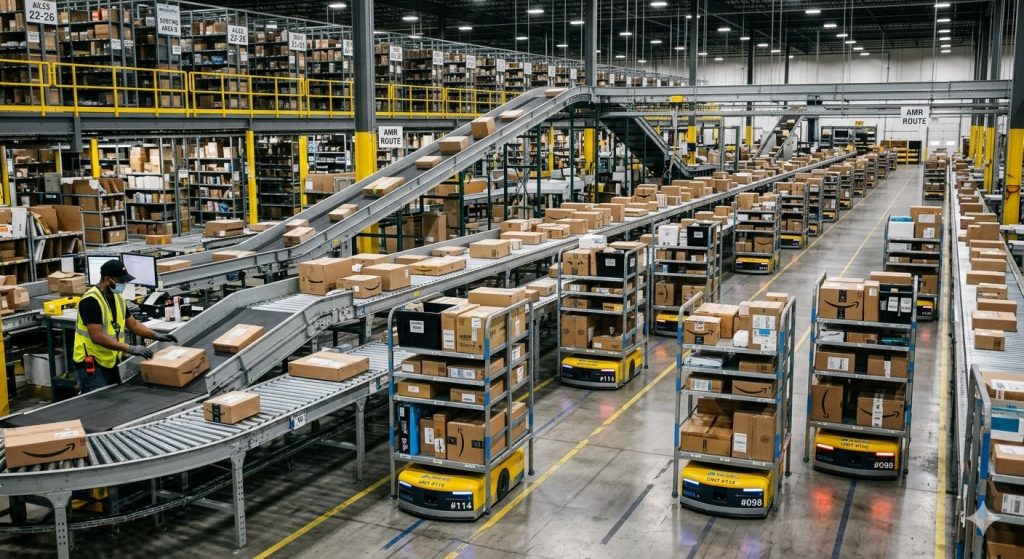
<p>Warehouse automation is the answer that the research and the market has converged on. The investment case is now well-established: automated picking systems, autonomous mobile robots (AMRs), AI-driven inventory forecasting, and integrated warehouse management platforms all generate documented returns in the European context. DHL’s deployments across its European network have demonstrated that AI-driven workload forecasting can meaningfully reduce idle robotic time and cut energy consumption simultaneously addressing both labour and sustainability cost pressures in a single intervention.</p>
<table width="624">
<tbody>
<tr>
<td width="208"><strong>20–30%</strong></p>
<p><strong>Inventory cost reduction from AI-driven demand forecasting</strong></td>
<td width="208"><strong>99.5%+</strong></p>
<p><strong>Inventory accuracy in leading automated European facilities</strong></td>
<td width="208"><strong>50%</strong></p>
<p><strong>Reduction in dispatch latency at top automated European retailers</strong></td>
</tr>
</tbody>
</table>
<p>The Fraunhofer Institute Germany’s leading applied logistics research body and the European Logistics Association have both documented that leading automated warehouses in Europe now achieve inventory accuracy above 99.5%, compared to averages of 80–85% in manually operated facilities. The margin implication is direct: fewer mispicks, fewer returns, lower write-offs, and faster throughput.</p>
<p>Perhaps more importantly, leading European retailers have demonstrated that the combination of AI-driven demand forecasting and real-time robotic task allocation can be transformative not just operationally, but commercially. Zalando’s use of AI across its fulfillment and customer-facing operations resulted in a 7% reduction in return rates among engaged users a number that, at the scale of hundreds of millions of annual returns across European e-commerce, translates into enormous cost savings. Its adjusted EBIT surged 46% between 2022 and 2024, with warehouse and fulfillment efficiency a central driver.</p>
<table width="624">
<tbody>
<tr>
<td width="624"><strong>STRATEGIC INSIGHT</strong></p>
<p>The labour shortage is permanent. Retailers who treat <a href="https://roblogistic.com/why-warehouse-automation-investments-fail-and-what-you-can-do-about-it/">warehouse automation</a> as a capital expenditure decision rather than a strategic imperative are underestimating the structural risk and the upside of moving early.</td>
</tr>
</tbody>
</table>
<p>A secondary warehousing trend worth watching is the convergence of WMS and TMS onto unified execution platforms — a challenge examined in detail in <a href="https://roblogistic.com/the-island-problem-in-warehouse-logistics/">the island problem in warehouse logistics</a>. Traditionally managed as separate technology stacks, the integration of these systems creates visibility across the inbound–warehouse–outbound chain that enables genuinely holistic flow management. This is particularly valuable in Europe, where cross-border complexity means that warehouse and transport decisions are tightly interdependent.</p>
<h3><strong>Layer 03 · </strong>LAST MILE</h3>
<h4><strong>Last Mile: Europe’s OOH Advantage</strong></h4>
<p>Last mile is where European e-commerce diverges most sharply from the US model and where European retailers have access to a structural cost advantage that their American counterparts largely do not.</p>
<p>Across Europe, the share of deliveries going to home addresses is declining. Consumers are increasingly choosing Out-of-Home (OOH) delivery parcel lockers and pickup points (PUDOs) as their default preference. This is not a marginal trend: in 2023, the number of automated parcel machines across Europe grew by 29% to nearly 155,000 units, while PUDO networks expanded to over 349,000 locations. Consumer preference for home delivery has fallen from 73% to 64% in just a few years and the direction of travel is clear.</p>
<p>For retailers and carriers, this shift is financially significant. Delivering to a locker or PUDO point reduces last-mile cost by 30–40% compared to home delivery, primarily because it eliminates the core economic problem of attended home delivery: failed first attempts. In dense urban environments, failed delivery rates for home delivery can reach 25% meaning one in four parcels requires a re-attempt, each one generating cost without generating revenue. Lockers virtually eliminate this failure mode, and open-network initiatives where multiple carriers share locker infrastructure push utilisation rates high enough to justify the capital investment.</p>
<table width="624">
<tbody>
<tr>
<td width="624"><em>“In Europe, the locker is becoming what the doorstep is in America the default endpoint of the delivery journey.”</em></td>
</tr>
</tbody>
</table>
<p>Major European carriers have recognised this and are investing accordingly. The pace of locker network expansion across the continent has been remarkable, with leading operators adding tens of thousands of new locker locations annually. The network effect is compounding as coverage increases, consumer adoption increases, which justifies further investment, which increases coverage further. Retailers who build OOH delivery into their proposition early offering it prominently and pricing it attractively are capturing this cost advantage at the customer acquisition stage, rather than bearing the full cost of home delivery as a default.</p>
<table width="624">
<tbody>
<tr>
<td width="208"><strong>30–40%</strong></p>
<p><strong>Last-mile cost reduction vs. home delivery via locker networks</strong></td>
<td width="208"><strong>25%</strong></p>
<p><strong>Failed first-attempt rate for urban home delivery</strong></td>
<td width="208"><strong>29%</strong></p>
<p><strong>Growth in European automated parcel machines in 2023 alone</strong></td>
</tr>
</tbody>
</table>
<p>The sustainability dimension is increasingly important here too, and not only for reputational reasons. European cities are progressively implementing Low Emission Zones (LEZs) — and non-compliant delivery vehicles face access restrictions and financial penalties that directly affect last-mile economics. Consolidated OOH delivery reduces the number of individual delivery trips into restricted urban areas, making it both a cost strategy and a compliance strategy simultaneously. Carriers operating electric cargo bikes for final delivery within these zones are already documenting significant emissions reductions and gaining preferential access to urban kerbs that translates into faster, cheaper delivery cycles.</p>
<table width="624">
<tbody>
<tr>
<td width="624"><span style="color: #000000;"><strong>STRATEGIC INSIGHT</strong></span></p>
<p><span style="color: #000000;">OOH delivery in Europe is not a niche option it is rapidly becoming the economically rational default. Retailers who present it as an attractive choice rather than a fallback will capture the margin while improving the customer experience.</span></td>
</tr>
</tbody>
</table>
<h3><strong>Conclusion · </strong>THE INTEGRATED MARGIN OPPORTUNITY</h3>
<h4><strong>The Integrated Margin Opportunity</strong></h4>
<p>The most important insight from the accumulated European research is that these three layers are not independent. Decisions made at the inbound stage affect warehouse complexity. Warehouse positioning affects last-mile reach. Last-mile delivery model choices loop back to affect returns volumes which land back in the warehouse. Retailers who optimise each layer in isolation will capture some of the margin available; retailers who design the system holistically will capture the compounding effect.</p>
<p>The European market is particularly well-suited to this systems approach. The continent’s regulatory environment, while complex, is moving in a consistent direction toward harmonisation, sustainability, and digital-first customs. The infrastructure for OOH delivery is maturing rapidly. And the labour crisis is forcing investment in automation that will improve warehouse economics for years to come.</p>
<p>For European e-commerce operators willing to think strategically about all three layers, the margin opportunity is substantial and the research is clear about where to start.</p>
<table width="624">
<tbody>
<tr>
<td width="624"><strong>Key Takeaways for European E-Commerce Leaders</strong></p>
<p><strong>1. </strong><strong>Inbound network design is a strategic decision. </strong>EU customs reform and VAT harmonisation are shifting the competitive balance toward EU-based fulfillment. Act before the window closes.</p>
<p><strong>2. </strong><strong>Warehouse automation is no longer optional. </strong>The European labour shortage is structural. The retailers investing in automation now are building a cost advantage that will compound over the coming decade.</p>
<p><strong>3. </strong><strong>OOH delivery is the European last-mile standard. </strong>A 30–40% cost reduction versus home delivery, combined with near-zero failed attempts, makes locker and PUDO delivery the rational default not a niche option.</p>
<p><strong>4. </strong><strong>Think across layers, not within them. </strong>The biggest margin gains come from integrated system design where inbound, warehouse, and last-mile decisions reinforce each other rather than creating hidden trade-offs.</p>
<p><strong>5. </strong><strong>Sustainability is margin-positive in Europe. </strong>LEZ compliance, OOH consolidation, and green last-mile investment all reduce cost as well as emissions — a genuine alignment of commercial and environmental interest.</td>
</tr>
</tbody>
</table>
<p> ;</p>

Where European E-Commerce Wins or Loses Its Margins