When we opened our Danish distribution center in Greve in 2019, I made a decision early on: we were going to run it the same way we run our Swedish warehouse in Strängnäs. Same WMS, same flow logic, same principles. It sounded straightforward. It was not.
This is the story of what it actually takes to replicate a working warehouse operation across a border, and why the hardest part had nothing to do with technology.
Building the Model: Strängnäs 2009 to 2019
Our Strängnäs warehouse was established in 2009 in a purpose-built facility of 8,650 square meters with 8-meter ceiling height, handling around 34,000 active article numbers, primarily automotive spare parts for our sister company Wismo Automotive.
The first three years were intense. We were not just setting up a warehouse, we were building a system for continuous improvement. We connected WMS functions step by step, one capability at a time, always pausing to evaluate before moving on. That discipline paid off. We optimized picking routes to reduce truck travel, introduced order consolidation, added scanning at the pick location and then on the article number itself to cut picking errors. Each step was deliberate and evaluated.
But the most important development was not in the system. It was in the people and the leadership.
We worked hard to build a flat, communicative, and humble leadership culture. Leaders and operators had real dialogue about improvement areas. We trained every employee on every task in the warehouse, which made work rotation possible. That rotation reduced repetitive strain, eliminated suboptimization, and gave us the flexibility to move resources where they were needed on any given day.
We also tackled something rarely discussed in logistics blogs: packaging. A large part of our inventory consists of body parts, doors, bonnets, front and rear fenders, windscreens, and tailgates. These are large, irregularly shaped, and easily damaged. We worked with a packaging supplier to develop custom corrugated cardboard solutions for each article group. We measured the articles, reduced the number of packaging models, simplified the closures, added ergonomic features for loading and unloading, and calibrated the board quality carefully. Some models needed stronger board to survive transport. Others had been over-engineered, and we could reduce the grade without any added risk. The result was packaging that protected the goods, simplified the work, and kept costs reasonable.
By 2019 we had a mature, proven model. Not perfect, but tested over ten years and built on real operational experience.
Entering Greve: A New Site, a New Challenge
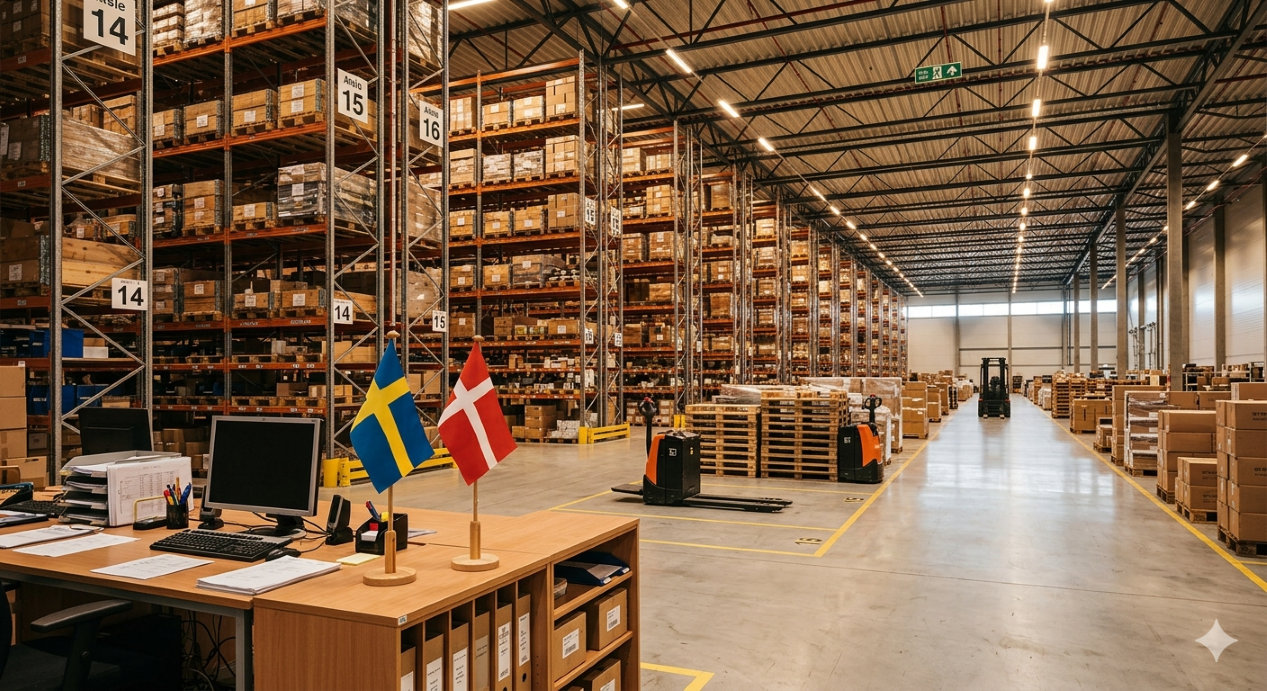
The Greve warehouse is larger, 14,000 square meters in total, including a dedicated 2,000 square meter tyre storage area with 8-meter ceiling height. The main spare parts warehouse runs to 12,000 square meters at 12-meter ceiling height, handling around 37,000 article numbers. Larger volume, larger throughput.
I was brought into the Greve project several months after it had already started. The building was already chosen, the racking was specified, and Kardex vertical lift modules had been selected. The layout was also set, or so I was told. I managed to revise the layout before it was too late, which was one of the first important decisions I made on the project. The rest I had to work with.
From the start I sketched the operational flow with Strängnäs as the template. We knew it worked. We knew the logic was sound for this type of logistics. And the scale difference, while real, was not so large that a different model was needed.
What I had not fully anticipated was the leadership challenge.
The Part Nobody Talks About: Leadership Culture
The operational model we had built in Strängnäs over ten years was not just a set of processes and system configurations. It was a leadership culture, one where warehouse managers and team leaders actively drove improvement from within, communicated openly with their teams, and created genuine two-way dialogue between operators and management.
That culture did not come with the blueprints. It had to be built from scratch in Greve, and it started with the people in key leadership positions.
Bringing in a new warehouse manager and supervisors who shared the right values and approach was the single most important factor in making the model work. Technical onboarding, WMS training, and process documentation were all straightforward by comparison. What took real time and deliberate effort was developing the same kind of open, feedback-driven leadership style that had grown organically in Strängnäs over years.
We focused on building trust before pushing change. We explained the reasoning behind decisions rather than just announcing them. We gave the team time to experience the benefits of the new ways of working before asking them to fully internalize them. And we made it clear that raising concerns and suggesting improvements was not just allowed, it was expected.
It took longer than the operational setup. But it is also what made the operational setup stick.
Why Harmonization Was Worth It
Today both warehouses run on the same WMS with the same flow logic. That alignment was not easy to achieve, but the return on the investment is clear.
The most practical benefit is that improvements travel freely between sites. If we find a better way to handle a picking sequence in Greve on a Monday, we can evaluate and implement it in Strängnäs by the end of the week. There is no translation layer, no compatibility problem, no need to rebuild something from scratch. The two operations speak the same language.
It also makes my role as logistics manager for both sites more manageable. I can read the same KPIs with the same definitions, compare performance meaningfully, and support both teams using the same frameworks and vocabulary.
What I Would Do Differently
I was not involved in the Greve project from the start. I was brought in several months after the project had already begun, which meant that key decisions about the building, racking, equipment, and layout had already been made without operational input. Some of those decisions created unnecessary constraints that could have been avoided.
The lesson here is not personal. It is structural. When a company establishes a new warehouse site, the logistics manager responsible for running it should be at the table from day one. Not after the lease is signed and the racking is ordered. Operational expertise needs to inform facility decisions, not adapt to them after the fact.
I would also have started the leadership culture work earlier and more explicitly. Making it an explicit project goal from day one, alongside the operational setup, would have helped.
The Lesson
A proven warehouse model is a genuine asset. But it is an asset that requires interpretation, not just installation.
The system, the flow, the WMS logic, the packaging solutions, all of that can be transferred. The leadership culture that makes it work has to be grown. That takes time, patience, and leaders who are willing to invest in their teams before expecting results from them.
If you are facing a similar challenge, start earlier than you think you need to, and spend at least as much time on the people as on the processes.