How the shift from AI that advises to AI that executes is redefining what it means to run a modern warehouse.
Walk into a warehouse running a state-of-the-art AI platform today and you will likely see something impressive. Dashboards pulse with real-time data. Predictive models flag potential stockouts before they happen. Demand forecasts update automatically. The system knows what is coming. But in most operations, a human still has to read those recommendations and decide what to do with them. The intelligence stops at the screen.
That is about to change. The next generation of AI in warehouse logistics does not stop at the recommendation. It acts on it. It does not send an alert. It reroutes the flow, reassigns the labor, triggers the replenishment, and notifies the carrier, all before the operations manager has finished their morning coffee.
This is what is meant by agentic AI, and it represents the most significant shift in warehouse technology since the introduction of automated material handling. Understanding what it is, what it can do, and where the real risks lie is increasingly essential for anyone who leads or manages a logistics operation.
What makes AI ‘agentic’?
The word agentic comes from the concept of agency: the capacity to act independently in pursuit of a goal. An agentic AI system does not just analyze a situation and surface an insight. It is given an objective, a set of tools it can use, and defined boundaries within which it operates, and then it pursues that objective autonomously, taking a sequence of actions, adapting based on feedback, and managing exceptions as they arise.
In practical terms, the difference between traditional AI and agentic AI looks like this:
| Traditional AI / ML | Agentic AI | |
| What it does | Analyzes data, generates recommendations | Makes decisions and executes actions autonomously |
| Human role | Reviews output, decides whether to act | Sets objectives and guardrails, reviews exceptions |
| Response time | Minutes to hours (human in the loop) | Seconds to milliseconds |
| Typical output | “You should reorder SKU-4471” | Replenishment order placed, carrier notified, staff reassigned |
| Value creation | Improves decision quality | Eliminates decision latency entirely |
The shift sounds incremental. In practice, it is transformational. Decision latency, the gap between a situation arising and a response being executed, is one of the most stubborn sources of inefficiency in warehouse operations. Agentic AI eliminates that gap.
The shift from predictive to agentic AI is not about smarter recommendations. It is about removing the human bottleneck from routine decision execution entirely.
Four areas where agentic AI changes the game
The applications vary by operation type, automation level, and order profile. But four areas consistently emerge as the highest-impact domains.
1. Dynamic exception management
Exceptions are the enemy of throughput. A carrier cancellation, a damage claim on inbound goods, a pick location running empty unexpectedly, a system mismatch between physical and book inventory. In a traditional operation, exceptions queue up for human resolution. The average exception takes between 15 and 45 minutes to work through, and in a busy operation there can be dozens per shift.
An agentic system treats exceptions as events to be handled, not problems to be escalated. It evaluates severity, checks available resolution paths, selects the optimal response based on current conditions, executes it, logs the action, and continues. A pick location running empty does not wait for a replenishment wave. The agent triggers spot replenishment from the nearest reserve location, reroutes the pick task in the meantime, and updates the wave plan to reflect the changed timing. All of this happens in seconds.
2. Real-time labor orchestration
Labor is typically the largest cost in a warehouse, and it is almost always underutilized and poorly distributed at the same time. One area is overwhelmed while another is idle. Supervisors move people reactively, based on what they can see on the floor, with a lag of ten to twenty minutes between a bottleneck forming and resources shifting to address it.
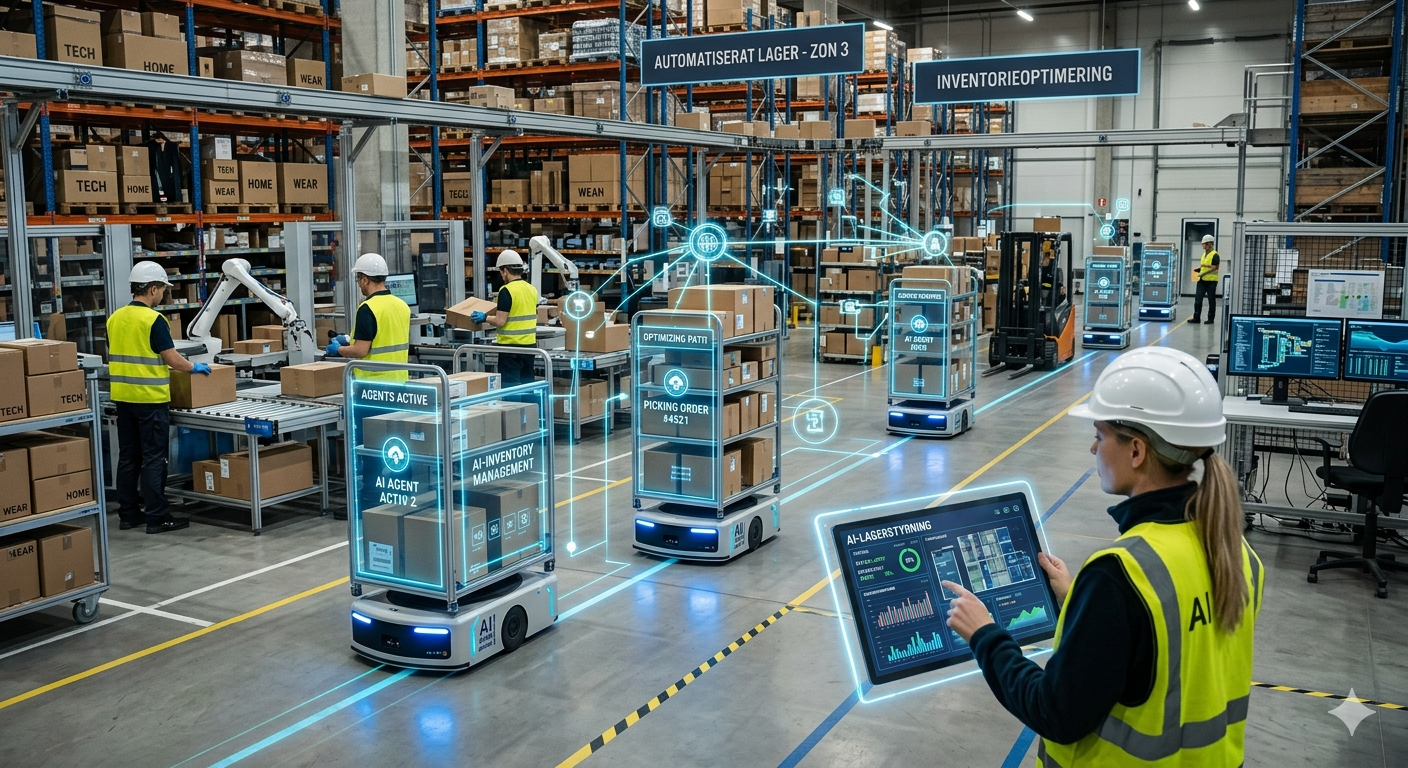
An agentic labor management system maintains a live model of workload, capacity, and throughput across every zone. When it detects an imbalance developing, it does not send a notification. It reassigns tasks, adjusts pick sequences to feed downstream areas more evenly, and if the operation uses a labor management system with gamification or task acknowledgement features, it communicates directly with workers. The supervisor is freed from constant rebalancing to focus on the issues that genuinely require human judgment.
3. Autonomous inventory positioning
Slotting optimization has long been one of the most valuable but least frequently executed processes in warehouse management. It is expensive in labor and system downtime, so most operations run a full reslotting exercise once or twice a year, even as order profiles shift daily.
Agentic AI enables continuous slotting. The system monitors pick frequency, travel distance, ergonomic constraints, and downstream sortation capacity in real time. When a product’s velocity changes, it schedules the move, assigns it to a low-activity window, issues the task, confirms the transfer, and updates the WMS record. Slotting becomes a living process rather than a periodic project. One large omnichannel retailer using continuous AI-driven slotting reported a reduction in picker travel distance of over 18 percent within the first quarter of operation.
4. Outbound transport coordination
The interface between the warehouse and the transport network has historically been a source of chronic inefficiency. Dock appointment scheduling, carrier selection, load consolidation decisions, and departure timing all require judgment calls that ripple across both domains simultaneously.
Agentic systems are beginning to bridge this boundary in ways that traditional TMS integration never achieved. An agent managing outbound coordination does not just book the cheapest available carrier. It weighs carrier cost against dock availability, against the wave completion forecast, against real-time traffic conditions, and against the customer’s SLA profile. It makes a decision that optimizes across all four dimensions simultaneously, and it executes that decision without waiting for a human to confirm what is clearly the right call.
Why now? The enabling conditions
Agentic AI has been theoretically possible for some time. What has changed in the past two to three years is the convergence of several enabling conditions that make it practically deployable at scale.
- Large language models and reasoning systems have matured to the point where they can handle ambiguous, multi-step decision problems reliably enough for operational use.
- Event-driven architecture has become the infrastructure standard in modern logistics platforms, providing the real-time data streams that agents need to perceive and act on the current state of the operation.
- API ecosystems have matured. WMS, WES, TMS, and labor management systems increasingly expose the interfaces that agents need to execute actions, not just read data. This is precisely the challenge described in the island problem in warehouse logistics.
- The cost of cloud compute has fallen far enough that running continuous AI inference at the scale a busy warehouse requires is now economically viable for mid-market operations, not just global tier-one shippers.
- Labor market pressures have fundamentally shifted the ROI calculation. The cost of expert human decision-making in operations is rising. The cost of AI decision-making is falling. The lines crossed somewhere around 2024 for a growing class of routine operational decisions.
These conditions are not temporary. They represent a structural shift in the economics of warehouse intelligence.
The risks are real and require serious design
Enthusiasm for agentic AI in logistics is warranted. But so is caution. Systems that act autonomously can act autonomously in the wrong direction, and in a warehouse, the consequences of bad decisions compound quickly.
The most important risk is objective misalignment. An agent optimizing for throughput without adequate constraints on accuracy rates, ergonomic limits, or equipment maintenance windows will find ways to maximize throughput that create serious problems downstream. Clearly defined objective functions with explicit constraint sets are not optional. They are the foundation of responsible agentic deployment.
The second risk is brittle confidence. Agentic systems can be highly effective within the distribution of situations they were trained on, and unexpectedly poor outside it. An unusual combination of events, a supplier failure, a sudden demand spike, a system outage, can produce decision sequences that look plausible locally but are catastrophic in aggregate. Human escalation paths and circuit breakers are not a sign of an immature system. They are a sign of a well-designed one.
An agent that cannot recognize the limits of its own competence and escalate accordingly is not a capable agent. It is a liability.
The third risk is organizational. Agentic AI changes what supervisors and managers do. If that change is not managed carefully, with clear communication, retraining, and a genuine redesign of roles, the technology will be adopted grudgingly and often subverted. The operations that capture the most value from agentic AI will be those where the human workforce understands what the system is doing, trusts it within its defined domain, and knows exactly when and how to override it.
What to look for when evaluating agentic systems
The market for agentic warehouse AI is moving fast and vendor claims are outpacing demonstrated results. When evaluating systems, five questions cut through most of the noise.
- What actions can the agent actually execute, versus what does it recommend? The list of native integrations to WMS, WES, TMS, and labor management systems is the most reliable indicator of real agentic capability.
- How are objective functions and constraints defined? Can operations teams configure them without vendor involvement? Rigidity here is a significant red flag.
- What is the escalation model? Under what conditions does the system surface a decision to a human rather than acting? Is that threshold configurable?
- How does the system explain its actions? Operational teams need to understand why the agent made the choices it did, especially when reviewing exceptions or investigating incidents.
- What does the performance baseline look like, and how is it measured? Vendors who cannot produce rigorous before-and-after data from comparable operations should be pressed hard on this point.
The warehouse that Runs itself, almost
The phrase ‘autonomous warehouse’ has been circulating in logistics marketing for the better part of a decade. Agentic AI is the closest the industry has come to making it a meaningful operational reality rather than a headline.
What is emerging is not a warehouse without people. It is a warehouse where people are freed from the relentless stream of routine micro-decisions that currently consumes so much of their cognitive bandwidth. The supervisor who spent every shift rebalancing labor zones can instead focus on the structural changes that improve the operation over months and years. The manager who fielded fifteen exception calls a day can focus on the carrier relationships and process improvements that create durable competitive advantage.
The technology is ready enough to deploy in a growing number of use cases. The organizational readiness to deploy it well is still the critical variable in most operations. Getting that right, defining objectives carefully, designing human-agent collaboration thoughtfully, and building the organizational trust that lets agentic systems operate at the speed they were built for, is the work that will separate the early winners from the early cautionary tales.
The gap between prediction and action has been one of the defining constraints of warehouse operations for decades. Agentic AI is closing it. The question for operators now is not whether to engage with this technology, but how quickly they can build the organizational capability to deploy it well.